
Streamlining the Move-Out Process
Enhancing Tenant Experience and Operational Efficiency
€77,840
in combined savings
+65%
pre-move-out completion

At a glance
Context
Resi (built on the Retrac platform): the move-in and move-out feature for student accommodation, where mass move-outs hit landlords' net operating income.
Role: Product designer and manager
The problem
In peak weeks, 20-25 move-outs a day overwhelmed staff. Landlords either hired and trained temporary workers or added permanent staff, both costly, and slow turnarounds left apartments empty.
What I did
I mapped stakeholders and pain points, set four goals, then designed digital move-out flows for tenants and landlords: early condition checks, scheduling and damage reporting, and bulk repair planning.
€77,840
combined savings at the client property
+65%
tenant pre-move-out completion
35 → <10 min
to process one move-out
200 → 8
units with a delayed move-in
The journey, in the order it happened
01Problem
The Problem
As the product designer and manager at Retrac, I was tasked with enhancing our flagship feature which digitalises the move-in and move-out processes for student accommodations. Managing mass move-outs efficiently is critical for large student accommodation owners as it directly affects their Net Operating Income (NOI).
Background
Retrac is a property management platform for landlords to manage student accommodations. Of the many features Retrac offers, move-in and move-out processes are its flagship. These processes are crucial, as they ensure operational efficiency and significantly affect landlords' net operating income (NOI). In Germany, most student move-outs occur between March and April and September and October, coinciding with the academic calendar.
Necessity
This feature is critical because of its direct impact on profitability, for example, 4 properties with 2000 units might experience 20-25 move-outs daily in September. Thus, Landlords face the seasonal challenge of handling mass move-outs, where traditional methods involve either hiring temporary workers—who require substantial training—or increasing permanent staff, both of which are costly and impact margins.
02Questions
Follow up questions
To guide our development process, we focused on finding answers to a key few questions first:
01
Who is this feature for?
02
What is the business impact?
03
Frequency of move-outs in a property?
04
Level of user training needed
03Terminologies
Few terminologies
To ensure clarity across our team and with stakeholders, we defined key terms. This made sure that we all referred to the same jargon while understanding the steps further.
- Inventory
- Movable items like furniture, appliances, and fixtures.
- Space Types
- Immovable structural elements like doors, walls, ceilings, and windows.
- Pre-moveout Report
- A document created by tenants detailing the existing condition of the apartment.
- Statuses for Landlords
- Categories like Pending, Scheduled, and Completed for tracking move-out processes.

04Competitors
Our Competitors

TurboTenant
https://www.turbotenant.com/Offers digital move-in/move-out reports with photo evidence to resolve disputes and streamline the inspection process.
Competitive Edge
Strong in documenting the property state but may not provide real-time scheduling and interactive move-out coordination.

Rentec Direct
https://www.rentecdirect.com/Provides mobile rental inspection capabilities which facilitate the move-in and move-out processes with inspection checklists.
Competitive Edge
Focuses on inspections but less on integrated scheduling and tenant-landlord communication throughout the move-out process.

Zillow Rental Manager
https://www.zillow.com/rental-manager/Helps manage listings, collects rent, and provides a tenant move-out checklist to track the condition of rental properties.
Competitive Edge
Provides a broad platform but may not offer the deep customization and tenant-specific features that facilitate a personalised move-out experience.
05Stakeholders
Stakeholders and User segments
To solve the problem, it was very important to know all the stakeholders of the move-out process and we listed them in primarily 4 different types.
Landlord/operation/ client heads: Focused on maintaining the overall health of property inventory for accurate annual reporting and efficient bulk ordering, reducing the need for extensive hiring and training.
Operation house masters: They manage daily operations, coordinate move-out dates, and ensure that the property is prepared for new tenants while handling multiple move-outs per day.
Cleaning and repair staff: Quickly prepare apartments for new tenants, often with minimal lead time.
Tenants: Need a smooth and well-organized move-out process to minimize disruption during this transitional period.
Digital Move-Out Process Flow (Stakeholder map)
A detailed stakeholder map outlines the responsibilities and interactions of each group. This helped us break down individual steps of the moveout process for our biggest client.
| The general flow | Landlord/ operation heads | Operation house masters | Cleaning and repair staff | Tenants |
|---|---|---|---|---|
| Initiate Pre-Moveout | - | Notify tenants and schedule preliminary move-out activities. | - | Receive notifications to initiate pre-moveout activities. |
| Complete Pre-Moveout Checklist | - | Review submitted checklists and handle any discrepancies or issues. | - | Complete and submit the checklist detailing the condition of the apartment. |
| Schedule and Confirm Move-Out Dates | - | Directly interact with tenants to finalise move-out dates. | - | Agree upon and confirm the scheduled dates for move-out. |
| Move-Out Day Operations | - | Supervise the move-out process, ensuring all activities are conducted smoothly. | Execute cleaning and repairs as per the finalised checklist. | Perform final move-out duties including property handover. |
| Post Move-Out Assessments | Oversee the assessment of the property and documentation of its condition. | Ensure all documentation is complete and stored appropriately. | - | - |
| Post Move-Out Assessments | Process security deposits and finalise the tenant's account. | - | - | Provide bank details for the deposit return and confirm the closure of their tenancy agreement. |
Initiate Pre-Moveout
Operation house masters
Notify tenants and schedule preliminary move-out activities.
Tenants
Receive notifications to initiate pre-moveout activities.
Complete Pre-Moveout Checklist
Operation house masters
Review submitted checklists and handle any discrepancies or issues.
Tenants
Complete and submit the checklist detailing the condition of the apartment.
Schedule and Confirm Move-Out Dates
Operation house masters
Directly interact with tenants to finalise move-out dates.
Tenants
Agree upon and confirm the scheduled dates for move-out.
Move-Out Day Operations
Operation house masters
Supervise the move-out process, ensuring all activities are conducted smoothly.
Cleaning and repair staff
Execute cleaning and repairs as per the finalised checklist.
Tenants
Perform final move-out duties including property handover.
Post Move-Out Assessments
Landlord/ operation heads
Oversee the assessment of the property and documentation of its condition.
Operation house masters
Ensure all documentation is complete and stored appropriately.
Post Move-Out Assessments
Landlord/ operation heads
Process security deposits and finalise the tenant's account.
Tenants
Provide bank details for the deposit return and confirm the closure of their tenancy agreement.
06Stakeholder Persona
Stakeholder Persona
After each stakeholder of the move-out process was identified along with their roles in different steps of the move-out lifecycle, it was important to interview people from each stakeholder to define a persona and understand their pain points.

Thomas King
49 / Male
Thomas has over 20 years of experience in property management, overseeing multiple residential complexes. He is focused on maximizing property value and ensuring smooth operations to boost profitability.
Details
- Age:
- 49 y.o.
- Name:
- Thomas King
- Occupation:
- Senior Property Manager
- Location:
- Berlin, Germany
- Education:
- Master’s in operations
Professional Goals:
- Enhance property value through diligent maintenance and upgrades.
- Achieve cost efficiencies in operations and maintenance.
- Improve tenant satisfaction and retention rates.
Pain Points:
- High maintenance costs and managing budgets.
- Coordinating with various teams for efficient move-outs and repairs.
- Ensuring all property data is accurately reported for compliance and decision-making.
Behavioral Traits:
- Decisive
- Strategic
- Technologically Savvy
- Leadership
- Communication
Scenarios:
- Preparing annual property performance reports that reflect maintenance status and profitability.
- Handling emergency maintenance issues efficiently to minimize tenant disruption and property damage.

Lisa Moreno
38 / Female
Lisa coordinates day-to-day operations and is the main point of contact for tenants during the move-out process. She prides herself on maintaining high standards for property readiness.
Details
- Age:
- 38 y.o.
- Name:
- Lisa Moreno
- Occupation:
- Operations Manager
- Location:
- Berlin, Germany
- Education:
- Bachelor’s in administration
Professional Goals:
- Streamline the move-out and move-in processes to minimize vacancy periods.
- Maintain excellent communication between tenants and the maintenance team.
Pain Points:
- Frequent scheduling conflicts and last-minute changes.
- Miscommunications leading to inefficiencies and tenant dissatisfaction.
Behavioral Traits:
- Proactive
- Organized
- Communicative
- Patient
- Problem Solver
Scenarios:
- Coordinating multiple move-outs in a single day, ensuring each is executed smoothly.
- Dealing with tenant complaints regarding move-out schedules or property conditions.

Michael Johnson
32 / Male
Michael leads a team responsible for the cleaning and repair tasks necessary for apartment turnovers. He is committed to high-quality standards and quick turnarounds.
Details
- Age:
- 32 y.o.
- Name:
- Michael Johnson
- Occupation:
- Head of Maintenance
- Location:
- Berlin, Germany
- Education:
- Technical Diploma
Professional Goals:
- Ensure all apartments are impeccably clean and fully functional for new tenants.
- Improve team efficiency and job satisfaction through better resource management.
Pain Points:
- Short lead times and high expectations for apartment readiness.
- Limited resources and occasional shortages of necessary supplies.
Behavioral Traits:
- Hands-on
- Efficient
- Stress Management
- Team Player
- Resourceful
Scenarios:
- Preparing multiple apartments for new tenants in a single day under tight deadlines.
- Managing unexpected repair issues while keeping to the move-out schedule.

Emily Carter
27 / Female
Emily is a young professional who values transparency and efficiency in her interactions with property management. She expects clear communication and a hassle-free move-out process.
Details
- Age:
- 27 y.o.
- Name:
- Emily Carter
- Occupation:
- Marketing Professional
- Location:
- Wernigerode, Germany
- Education:
- Bachelor’s in Marketing
Goals:
- Successfully relocate to a new apartment without disputes or unexpected costs.
- Ensure the move-out process is handled fairly, particularly concerning the security deposit.
Pain Points:
- Unclear move-out procedures and unexpected costs that arise during the process.
- Concerns about the full return of the security deposit and the fairness of damage assessments.
Behavioral Traits:
- Responsible
- Digital Native
- Technologically Savvy
- Concerned
- Communication
Scenarios:
- Completing the pre-moveout checklist and scheduling the final inspection.
- Resolving discrepancies in the move-out report to ensure a fair deposit return.
07Goals
Goals
Based on our analysis, we set four primary goals to solve this problem.
- Reduce operational redundancies.
- Enhance the tenant experience during move-out.
- Provide early assessments of apartment conditions.
- Offer insights for follow-up tasks to minimise downtime before the next move-in.
08Pain Points and Solutions
Pain points
After conducting multiple interviews with all the stakeholders, our team broke down the most important pain points in the current process and also we set a priority number for each of these pain points.
Landlord/Operation/Client Heads
Pain Point
- No knowledge of the overall health of a property.
- Many move-ins do not happen on the scheduled move-in date.
- Inaccurate bank account details collected
- Non-standardized charges for damages and cleaning
- Need for additional hires during peak move-out periods
- Training new hires on move-out procedures
Operation House Masters
Pain Point
- Uncertainty about when to initiate move-out discussions.
- Challenges in deciding on move-out dates with tenants.
- Managing multiple move-outs on a single day.
- Uncertainty in charging for specific damages.
- Handling unexpected repair issues.
- Issues with accurately reporting bank details.
Cleaning and Repair Staff
Pain Point
- Lack of clarity on task assignments.
- Constant need for schedule coordination
Solutions Proposed
After listing all the pain points and their associated priority numbers, the team was ready to find solutions for the highest-priority pain points. The table below lists all the solutions to their corresponding pain points and also associates a number to prioritise the solution.
Pre-moveout process for tenant assessment
Ensures properties are maintained and ready for the next tenant while accessing the problems at the earliest.
Corresponding Pain Point
No knowledge of the overall health of a property.
RESI-176
Flexible move-out scheduling with tenant input
Improves tenant satisfaction and operational efficiency.
Corresponding Pain Point
No knowledge of the overall health of a property.
RESI-177
Standardisation of damage and cleaning charges
Reduces disputes and streamlines billing processes.
Corresponding Pain Point
Non-standardized charges for damages and cleaning.
RESI-178
Inventory mapping and damage assessment
Provides clear guidelines for assessing apartment conditions.
Corresponding Pain Point
Uncertainty in charging for specific damages.
RESI-179
Mandatory tenant bank details collection
Ensures efficient and accurate processing of security deposits.
Corresponding Pain Point
Inaccurate bank account details collected.
RESI-180
Automated scheduling and notification system
Reduces the workload of managing multiple move-outs.
Corresponding Pain Point
Managing multiple move-outs on a single day
RESI-181
Training modules for move-out procedures
Enhances the skill set and efficiency of new hires.
Corresponding Pain Point
Training new hires on move-out procedures
RESI-181
Prioritisation of Solutions Using RICE Framework
| Solution | Reach | Impact | Confidence | Effort | RICE Score |
|---|---|---|---|---|---|
| Pre-moveout process for tenant assessment | 10 | 10 | 90 | 15 | 60 |
| Flexible move-out scheduling with tenant input | 9 | 9 | 80 | 20 | 32.4 |
| Standardization of damage and cleaning charges | 8 | 8 | 70 | 10 | 44.8 |
| Mandatory tenant bank details collection | 7 | 8 | 85 | 15 | 39.2 |
| Inventory mapping and damage assessment | 8 | 7 | 90 | 25 | 20.16 |
| Automated scheduling and notification system | 6 | 9 | 80 | 30 | 14.4 |
| Training modules for move-out procedures | 5 | 8 | 75 | 40 | 7.5 |
Pre-moveout process for tenant assessment
Reach
10
Impact
10
Confidence
90
Effort
15
RICE Score
60
Flexible move-out scheduling with tenant input
Reach
9
Impact
9
Confidence
80
Effort
20
RICE Score
32.4
Standardization of damage and cleaning charges
Reach
8
Impact
8
Confidence
70
Effort
10
RICE Score
44.8
Mandatory tenant bank details collection
Reach
7
Impact
8
Confidence
85
Effort
15
RICE Score
39.2
Inventory mapping and damage assessment
Reach
8
Impact
7
Confidence
90
Effort
25
RICE Score
20.16
Automated scheduling and notification system
Reach
6
Impact
9
Confidence
80
Effort
30
RICE Score
14.4
Training modules for move-out procedures
Reach
5
Impact
8
Confidence
75
Effort
40
RICE Score
7.5
09User flows
User Flow: Mapping the Journey
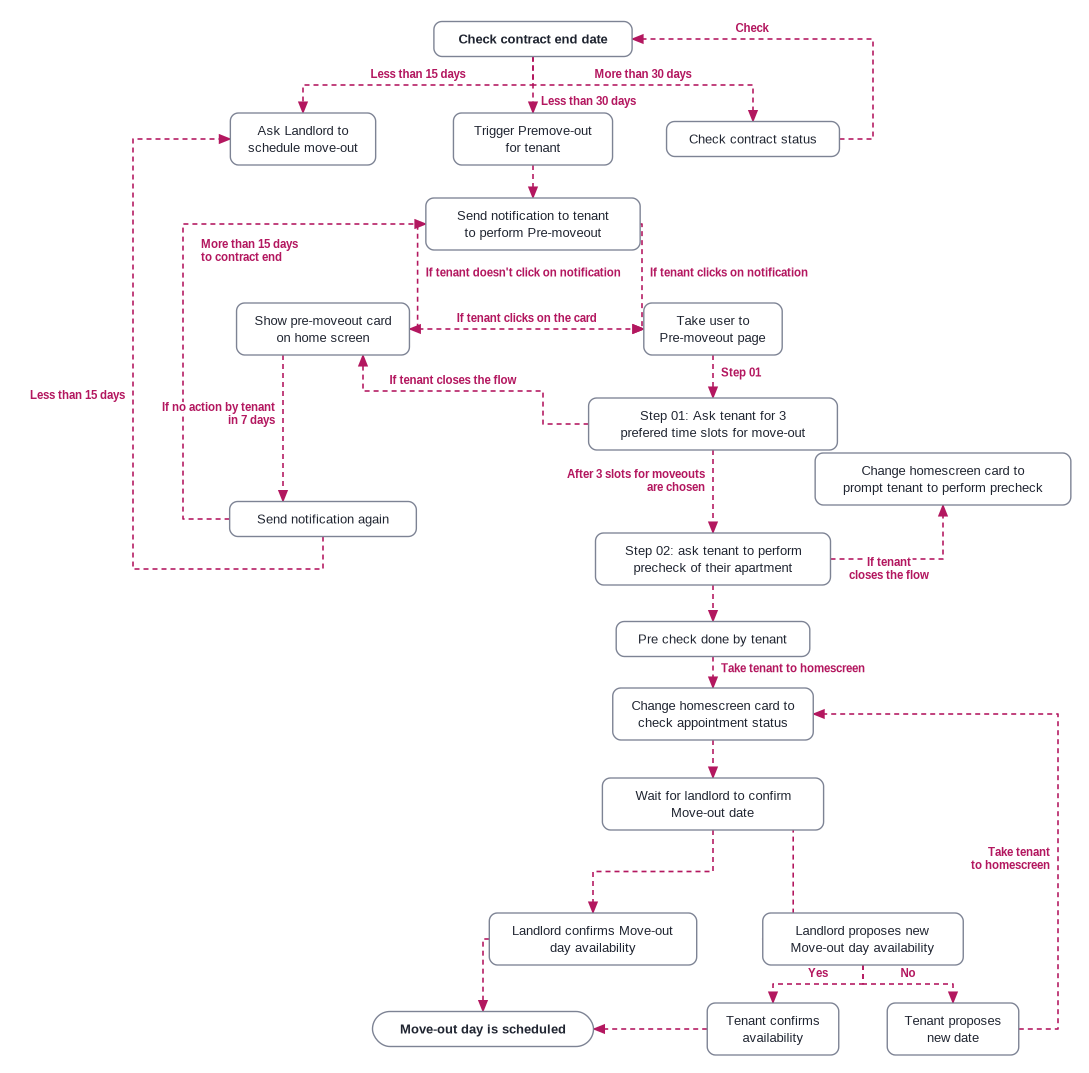
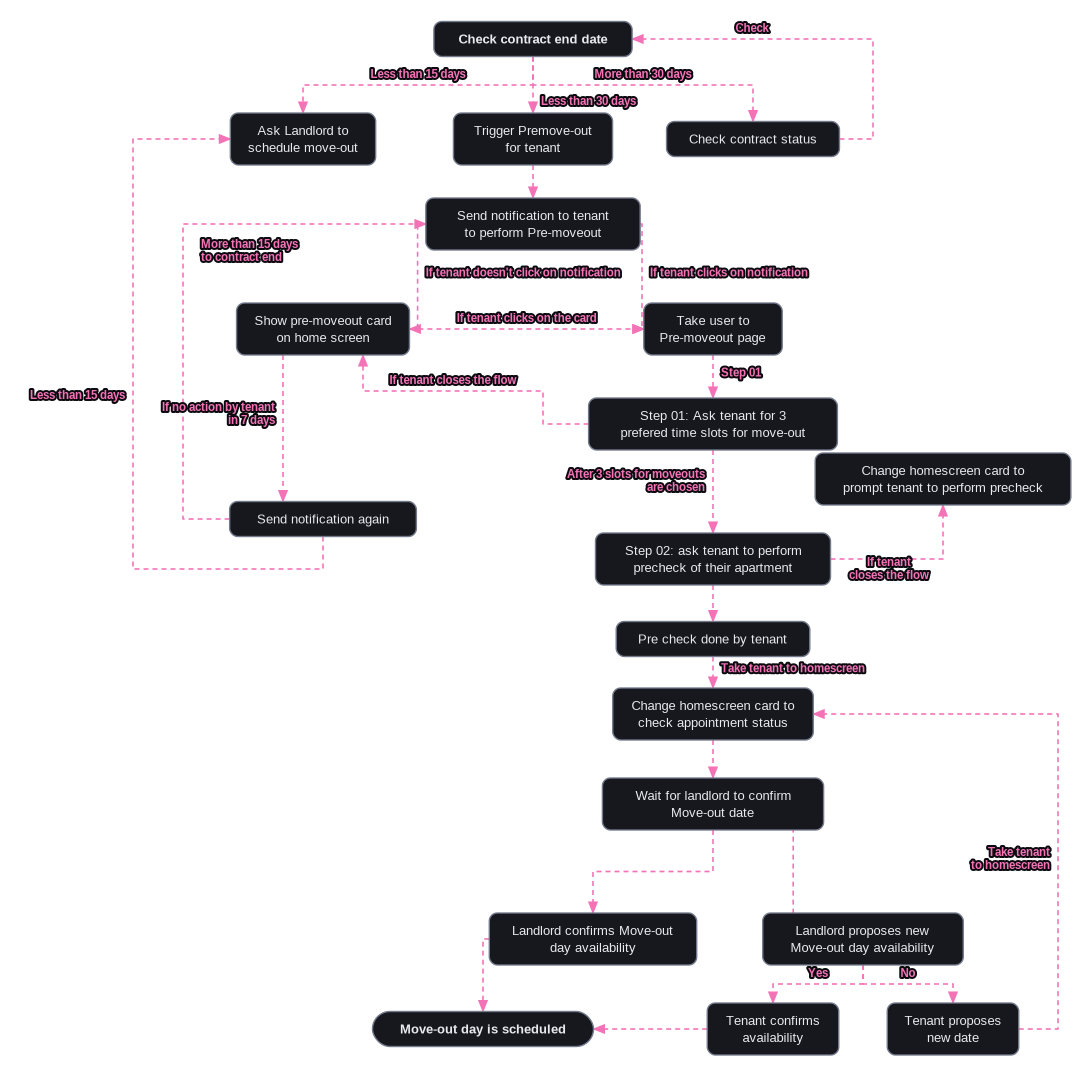
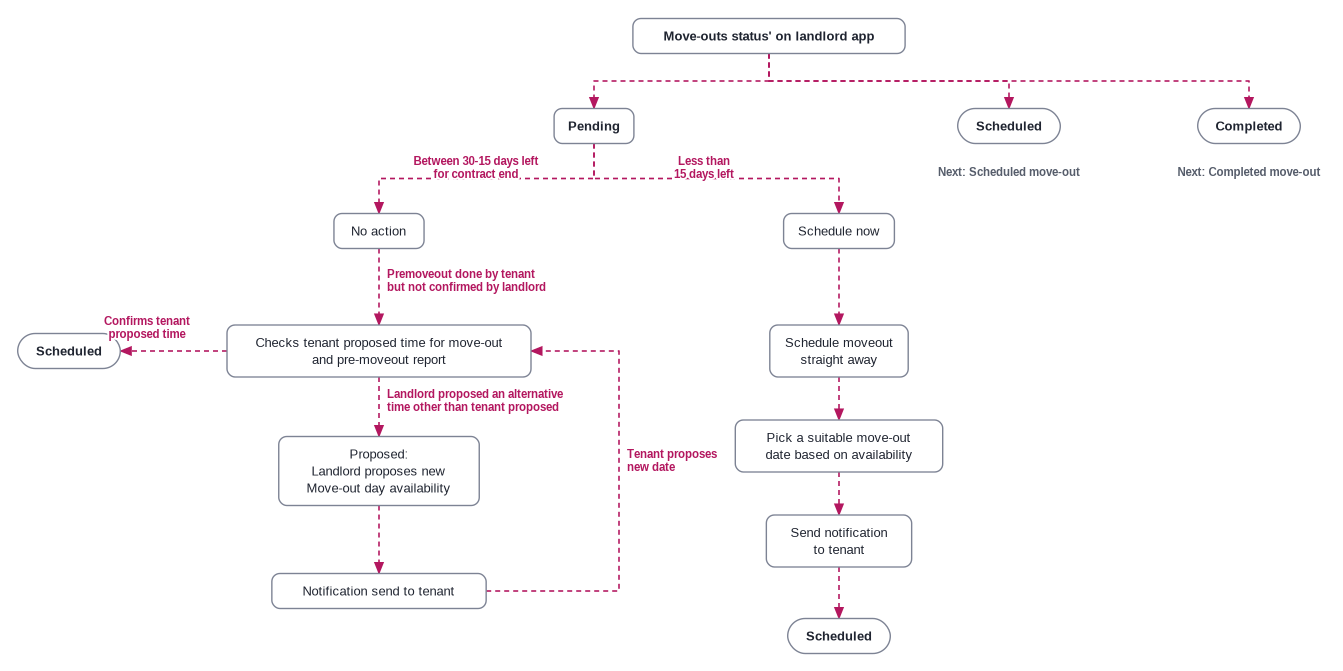
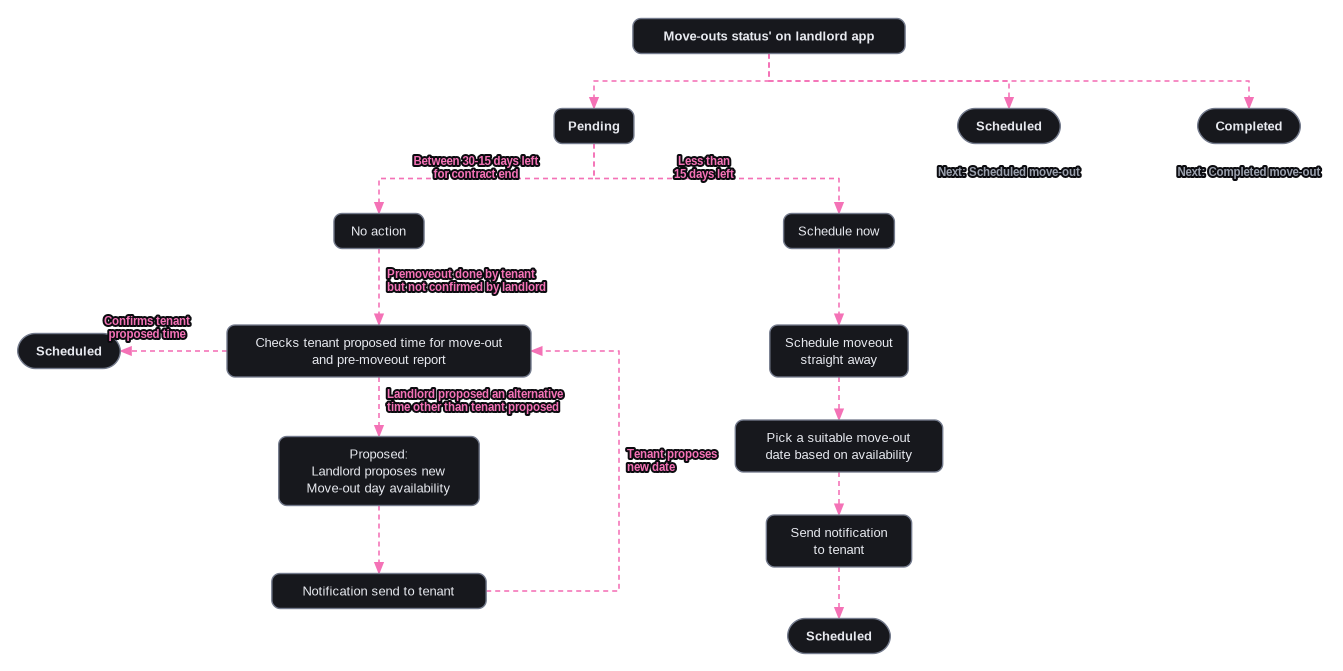
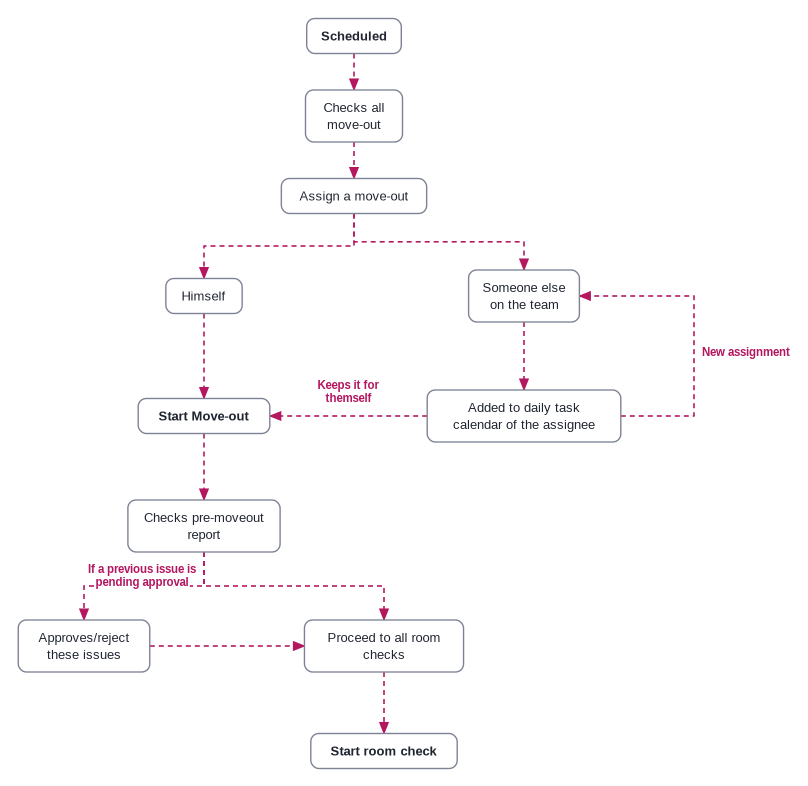
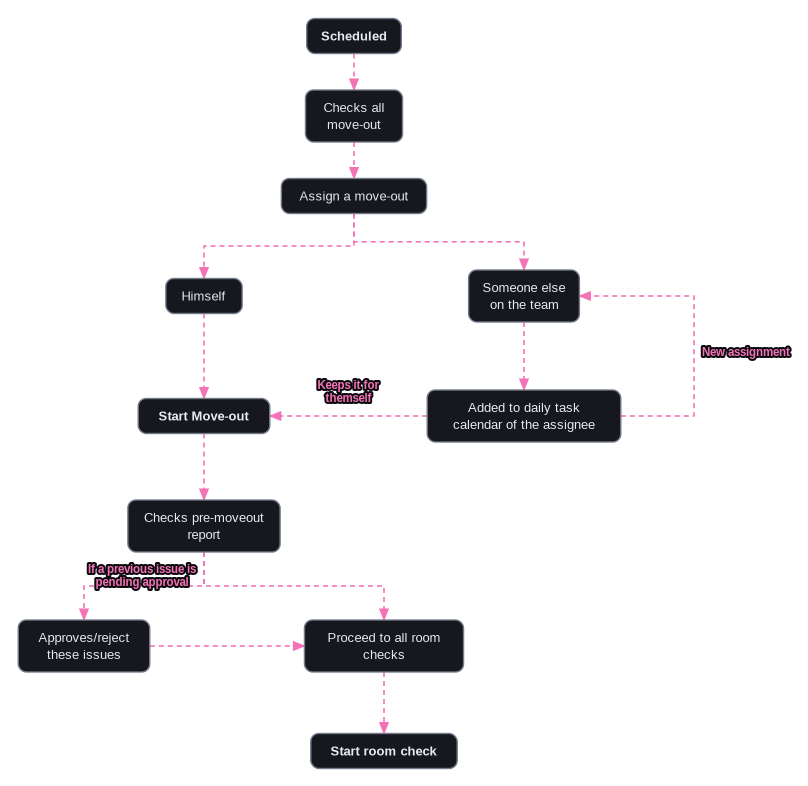
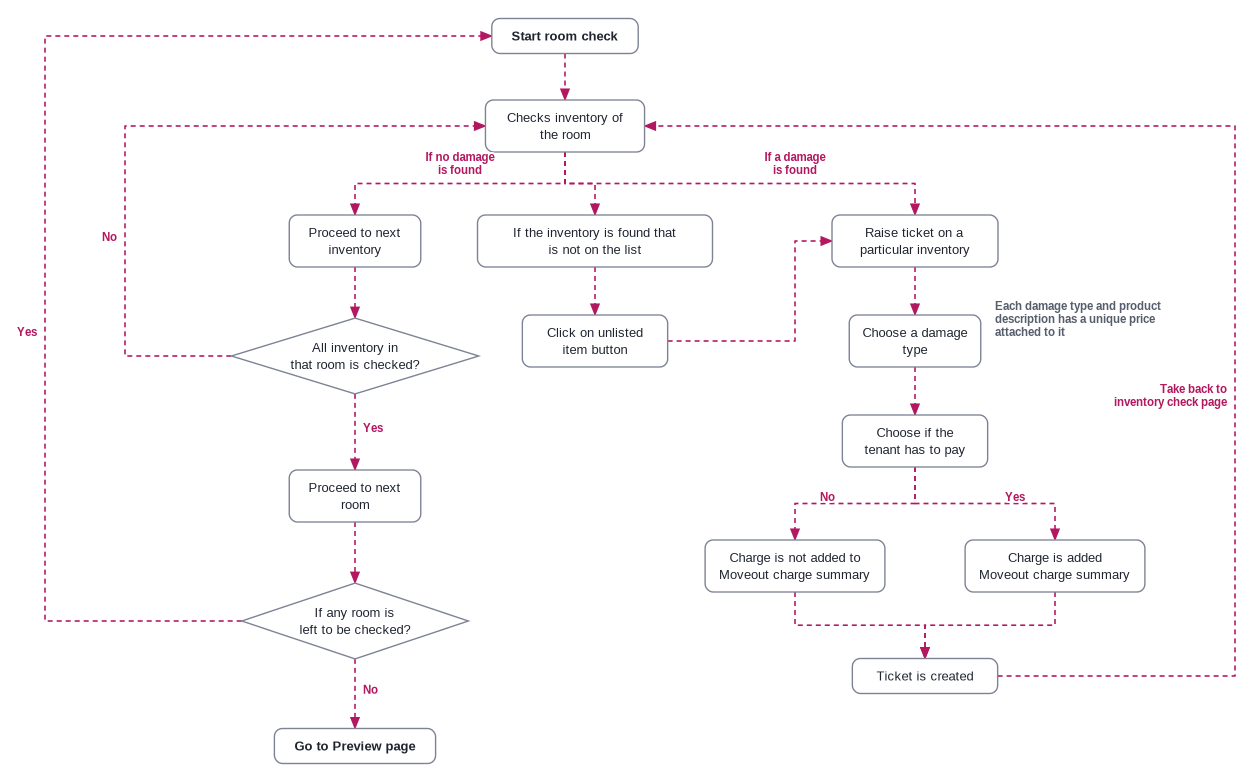
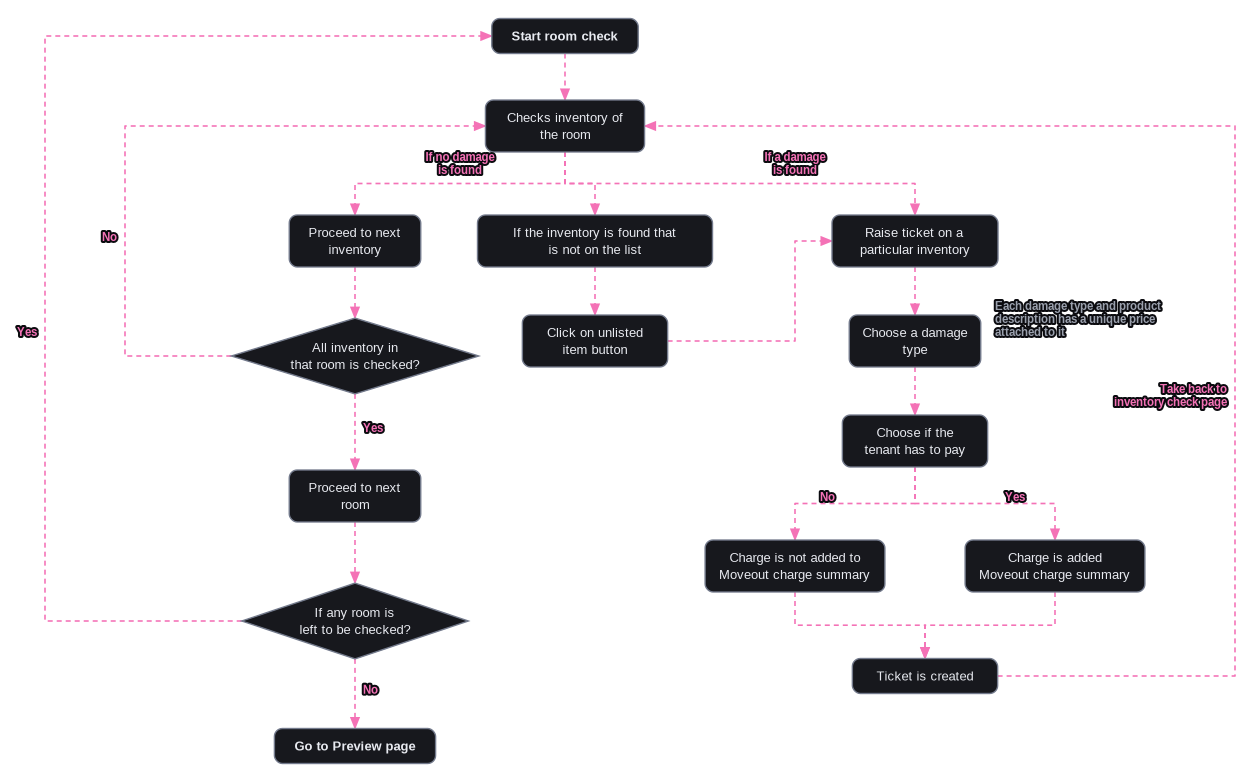
After prioritizing our solutions using the RICE matrix, our next crucial step was creating comprehensive user flows. This phase brought our tech and product teams together, allowing us to visualize the optimal path for each stakeholder. These flows served as the foundation for our low-fidelity prototypes, enabling us to test our solutions and iterate at the prototype stage while ensuring technical feasibility.
Flow: Tenant app
Flow: Landlord app
1. Move-out statuses
2. Assigning and starting a move-out
3. Room checks and damage tickets
4. Summary, attendance and sign-off
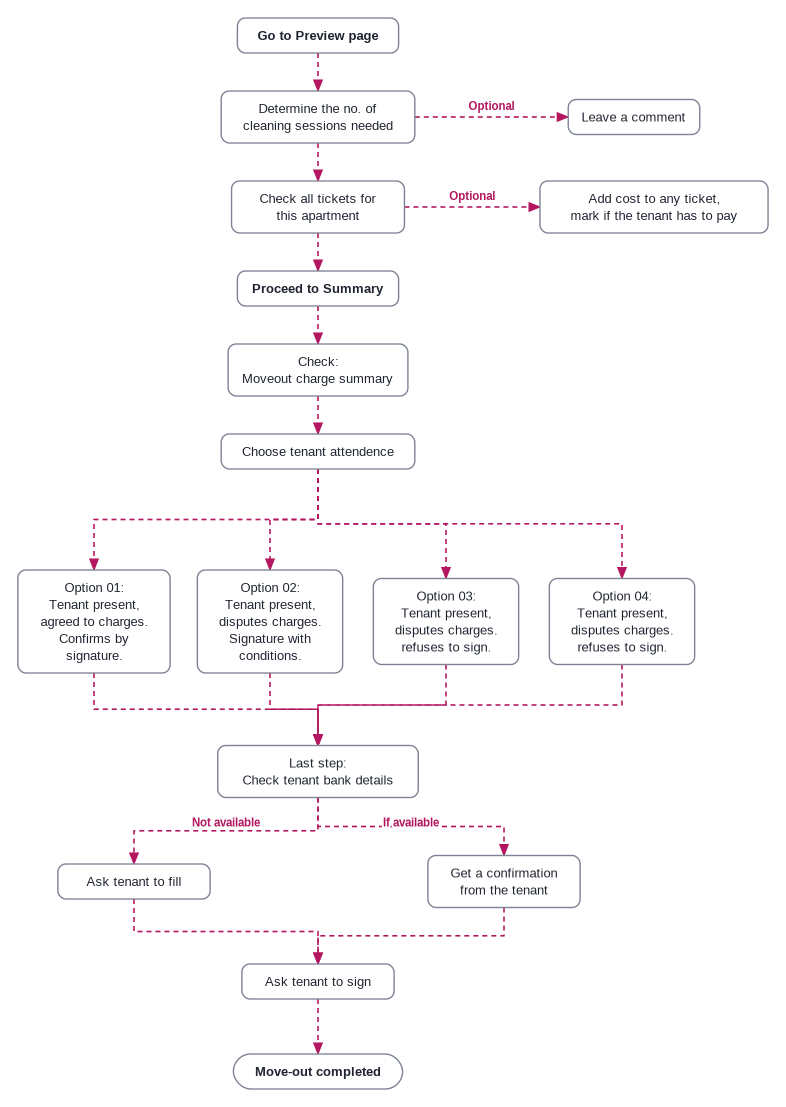
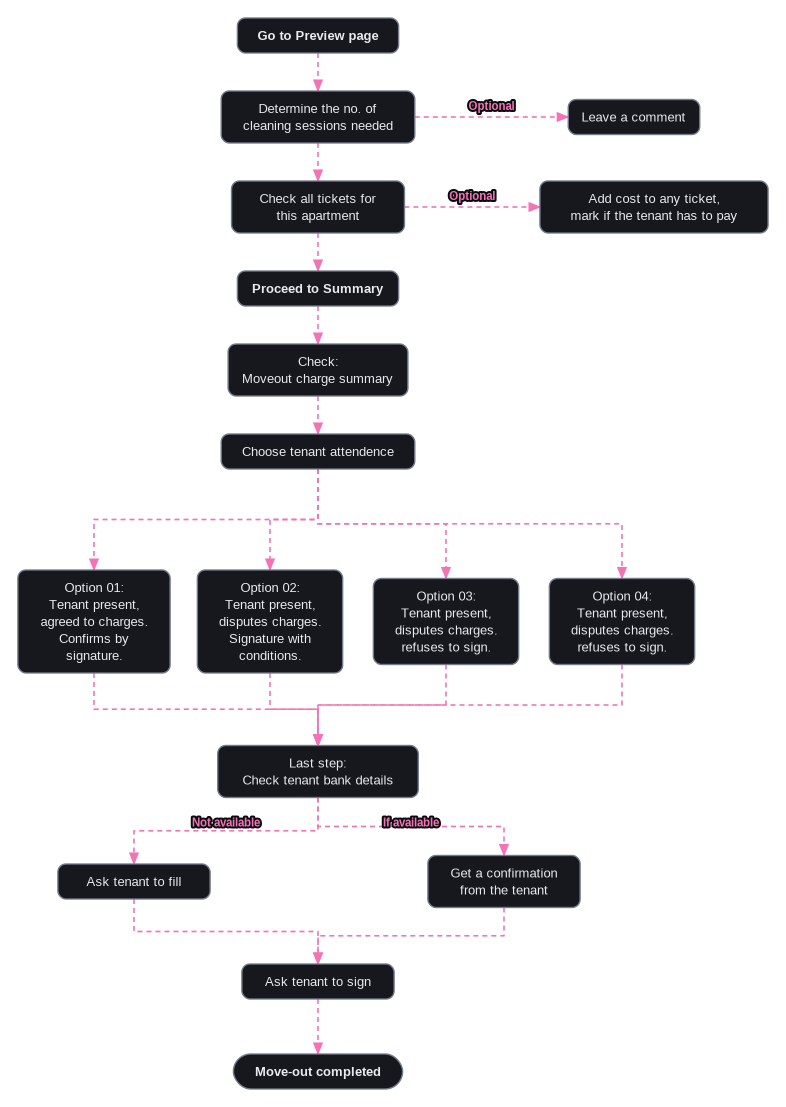
5. Completed move-outs
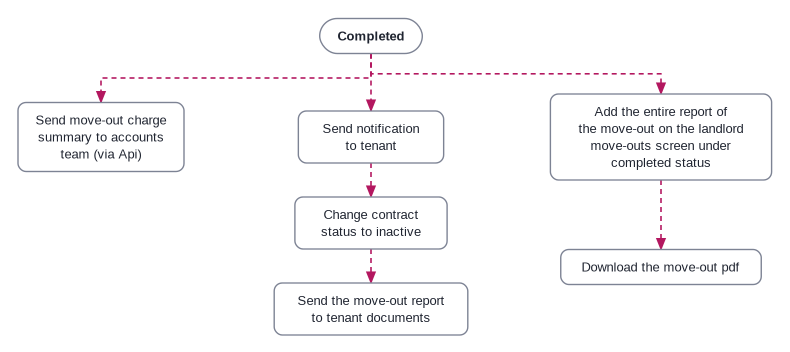
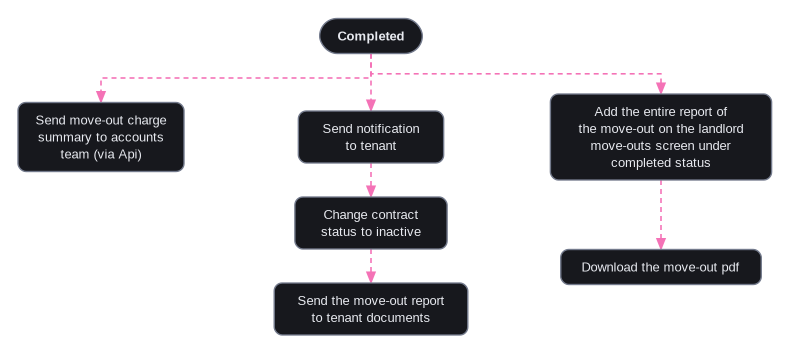
10Wireframe and prototypes
Developing wireframe and prototypes
After developing our initial prototype, my team and I conducted extensive testing sessions with all stakeholder groups. This phase proved invaluable, revealing several critical issues that needed addressing before the final implementation.
Tenant app wireframe
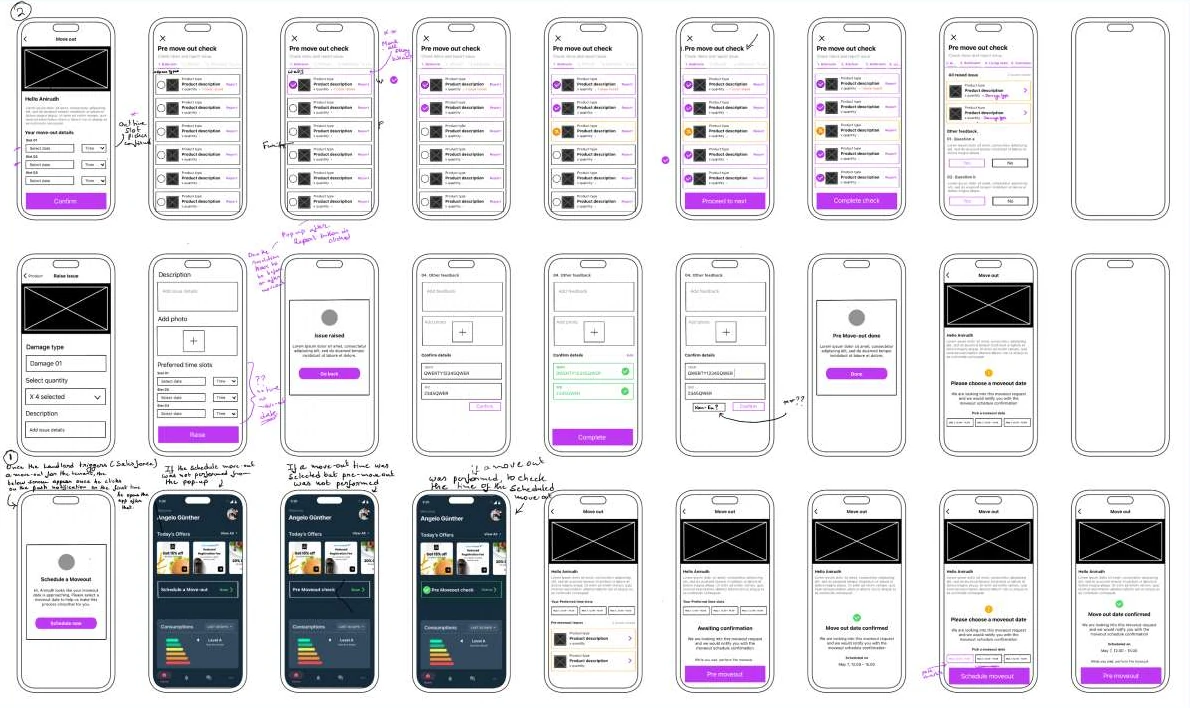
Swipe sideways to exploreOpen full size
Landlord app wireframe
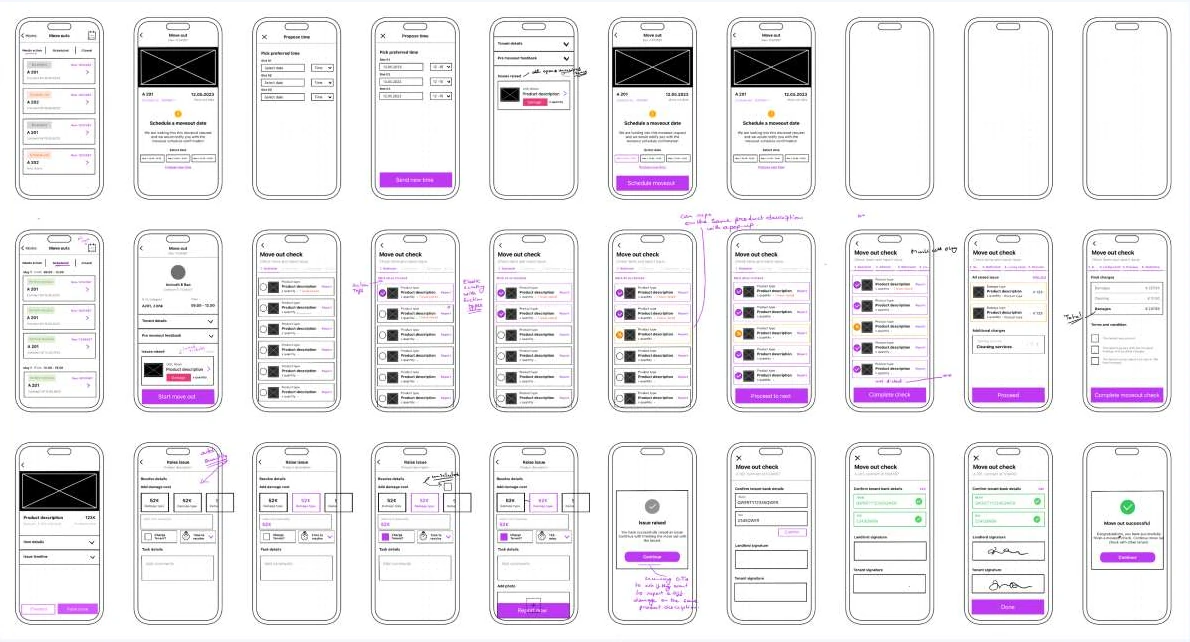
Swipe sideways to exploreOpen full size
Key Issues Discovered
During our testing phase, we identified four major challenges.
| Issue | Problem | Pain point | Impact |
|---|---|---|---|
| Overwhelming Pre-moveout Process | Tenants found the comprehensive pre-moveout checklist overwhelming. | The requirement to check every inventory item and space in the apartment was too demanding. | This could lead to poor completion rates and inaccurate reporting. |
| Cleaning Charges Confusion | Landlords expressed confusion about cleaning charges across different property types. | Lack of standardization made it difficult to quickly assign appropriate cleaning costs. | This caused inconsistencies in charging and increased the time needed for move-out processing |
| Bank Details Collection Bottleneck | Collecting bank details during final move-out created time delays | Particularly problematic during peak periods with multiple move-outs. | Created a ripple effect of delays throughout the day's scheduled move-outs. |
| Rigid Scheduling System | Strict time-specific scheduling led to cascading delays | A single delayed move-out affected all subsequent appointments. | Created stress for both property managers and tenants. |
Overwhelming Pre-moveout Process
Problem
Tenants found the comprehensive pre-moveout checklist overwhelming.
Pain point
The requirement to check every inventory item and space in the apartment was too demanding.
Impact
This could lead to poor completion rates and inaccurate reporting.
Cleaning Charges Confusion
Problem
Landlords expressed confusion about cleaning charges across different property types.
Pain point
Lack of standardization made it difficult to quickly assign appropriate cleaning costs.
Impact
This caused inconsistencies in charging and increased the time needed for move-out processing
Bank Details Collection Bottleneck
Problem
Collecting bank details during final move-out created time delays
Pain point
Particularly problematic during peak periods with multiple move-outs.
Impact
Created a ripple effect of delays throughout the day's scheduled move-outs.
Rigid Scheduling System
Problem
Strict time-specific scheduling led to cascading delays
Pain point
A single delayed move-out affected all subsequent appointments.
Impact
Created stress for both property managers and tenants.
Iterative Solutions
Working closely with our development team, we implemented targeted solutions for each issue.
| Solution | Changes | Implementation | Result |
|---|---|---|---|
| Streamlined Pre-moveout Flow | Redesigned the pre-moveout process to focus on essential questions | Made detailed reporting optional while maintaining key health checks | Better completion rates while still gathering crucial apartment condition data |
| Standardized Cleaning Charges | Introduced a session-based cleaning charge structure | Created a dashboard feature where landlords could pre-set cleaning charges for different property types | More consistent and efficient cleaning cost assignments |
| Proactive Bank Information Collection | Moved bank detail collection to the pre-moveout phase | Integrated bank information requests into the initial pre-moveout flow | Eliminated a major bottleneck from the final move-out day |
| Flexible Time Slot System | Replaced specific times with 3-hour time slots. | Created broader time windows for move-out scheduling | Better buffer for delays and more realistic scheduling expectations |
Streamlined Pre-moveout Flow
Changes
Redesigned the pre-moveout process to focus on essential questions
Implementation
Made detailed reporting optional while maintaining key health checks
Result
Better completion rates while still gathering crucial apartment condition data
Standardized Cleaning Charges
Changes
Introduced a session-based cleaning charge structure
Implementation
Created a dashboard feature where landlords could pre-set cleaning charges for different property types
Result
More consistent and efficient cleaning cost assignments
Proactive Bank Information Collection
Changes
Moved bank detail collection to the pre-moveout phase
Implementation
Integrated bank information requests into the initial pre-moveout flow
Result
Eliminated a major bottleneck from the final move-out day
Flexible Time Slot System
Changes
Replaced specific times with 3-hour time slots.
Implementation
Created broader time windows for move-out scheduling
Result
Better buffer for delays and more realistic scheduling expectations
These iterations demonstrated the value of our user-centric design approach and agile development process. By actively listening to user feedback and quickly implementing solutions, we were able to transform potential roadblocks into opportunities for improvement. The final design not only addressed these specific issues but created a more robust and user-friendly system overall.
11Design process
The Design process
The redesign process of the product’s visuals and features involved utilising the basic brand guidelines, which includes colours, fonts, and illustration styles that already established in the design system.
We’re all added new components into the existing set of components and used the principles of Atomic Design to develop the feature screens.
The Components Developed
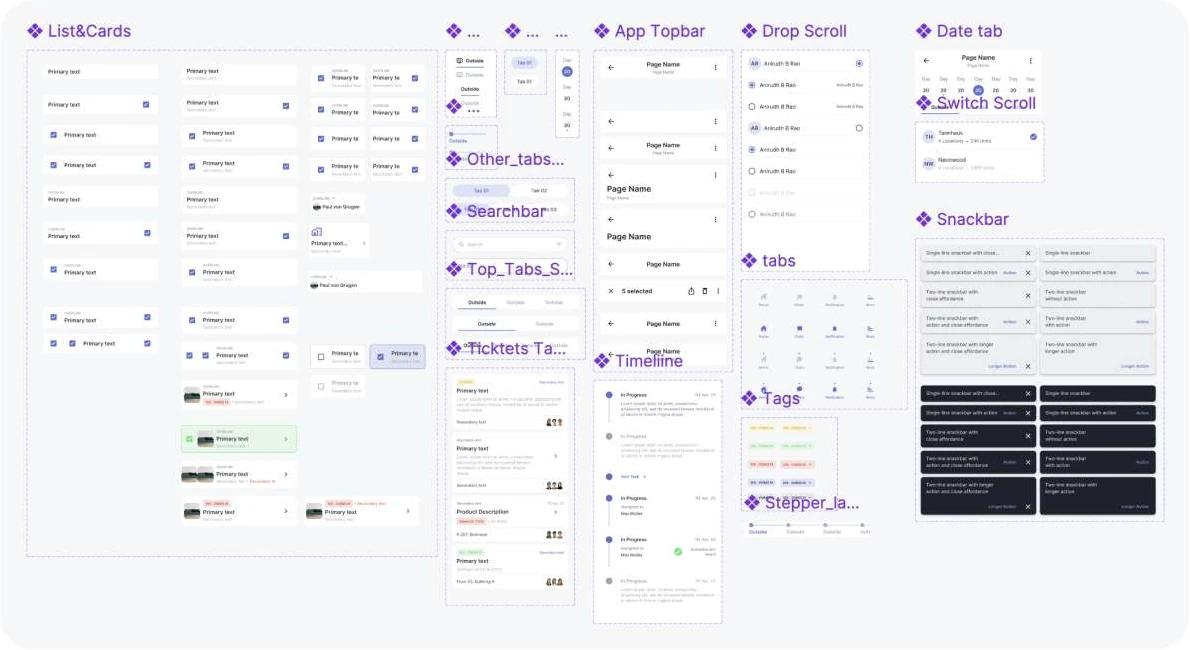
Swipe sideways to exploreOpen full size
Atomic Design
The principles of Atomic Design was used to develop the feature screens.
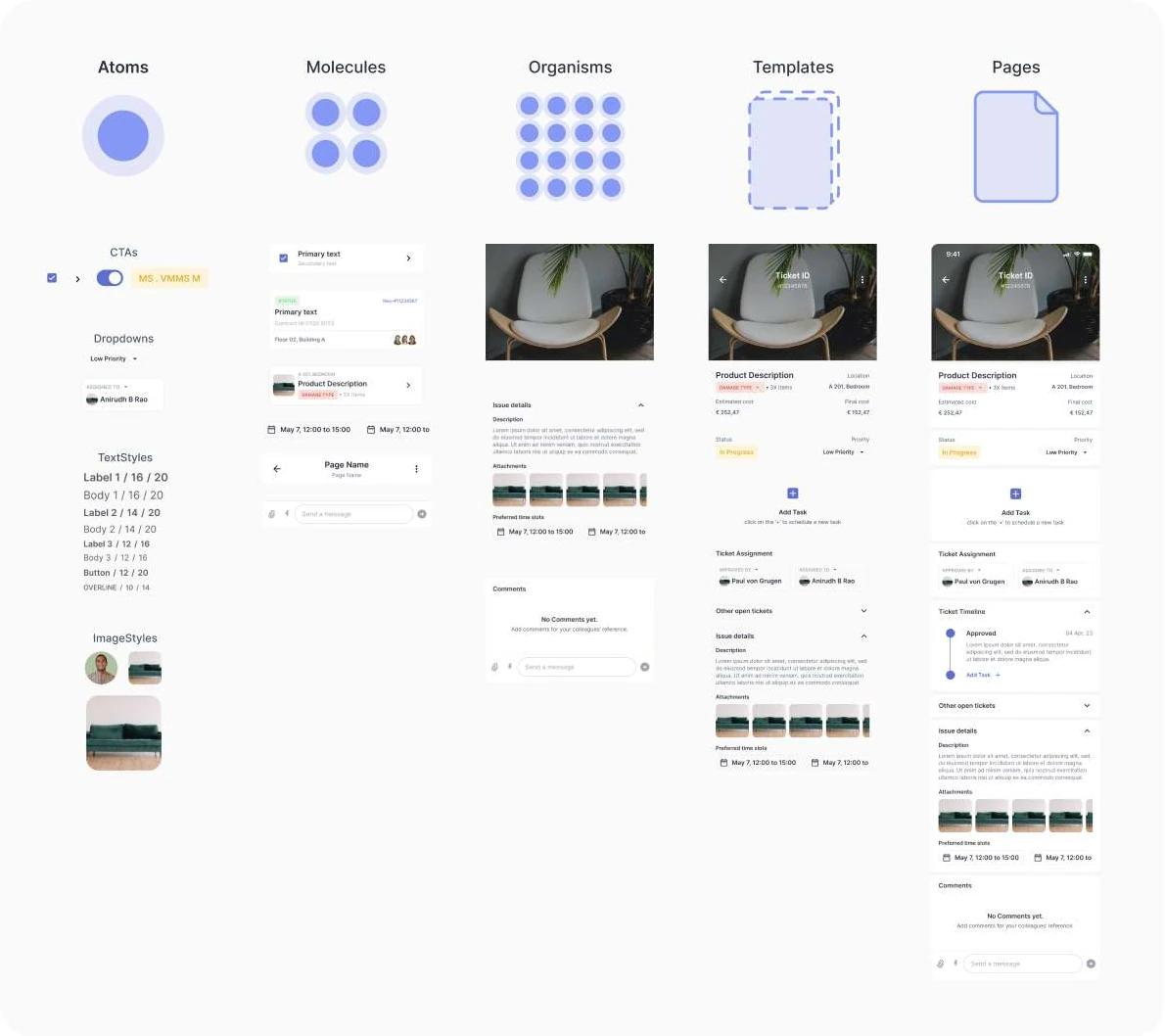
Swipe sideways to exploreOpen full size
12The Main Features
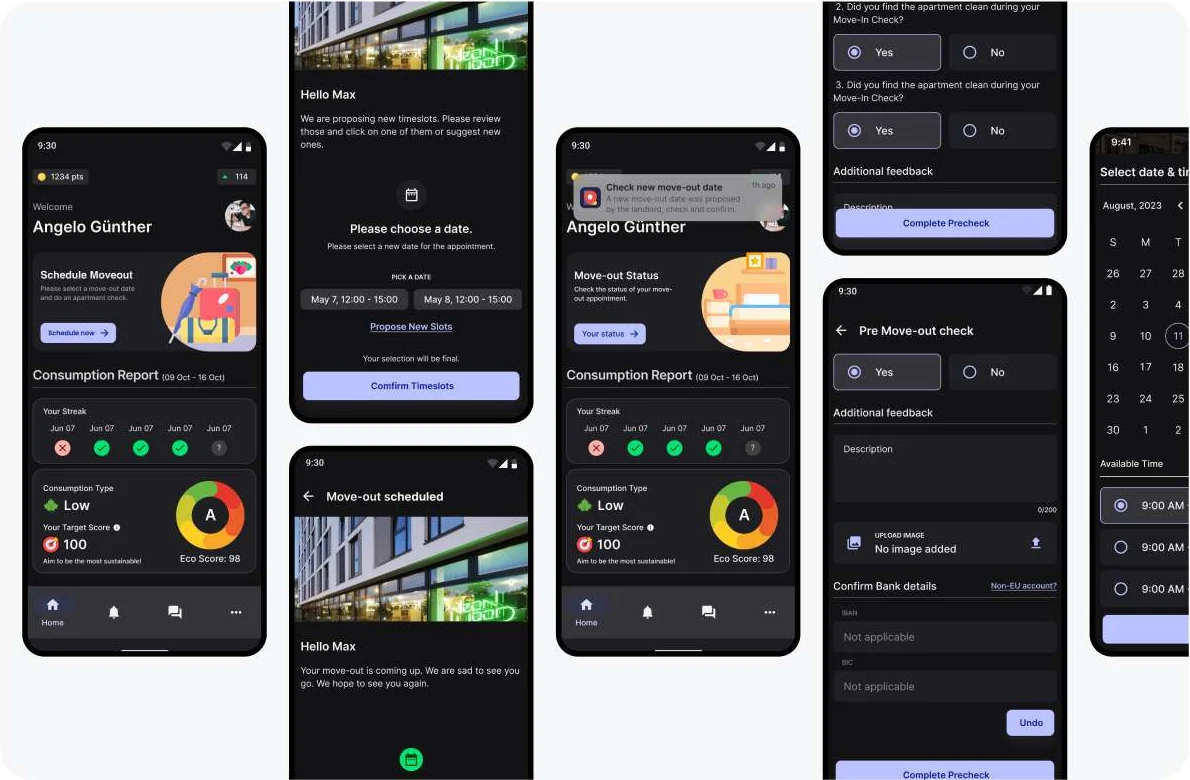
The Tenant App
The Tenant App was designed with the goal of simplifying the tenant’s move-out experience while addressing key pain points identified during the research phase. The design process focused on creating an intuitive interface and seamless workflows to reduce friction for tenants during this transition.
Swipe sideways to exploreOpen full size
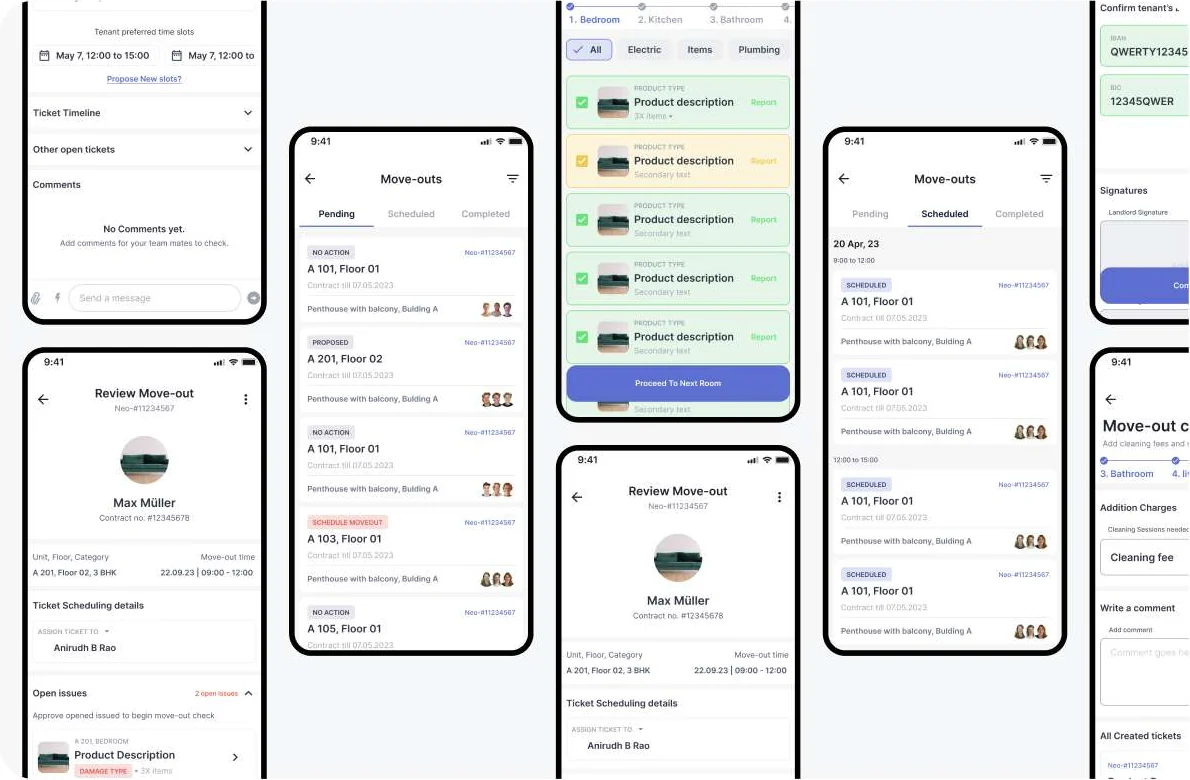
The Landlord App
The Landlord App was designed with a clear focus on functionality to address the complex operational requirements of landlords and property managers during the move-out process. The app prioritised efficiency, control, and adaptability, ensuring landlords have the tools they need to handle a variety of situations effectively.
Swipe sideways to exploreOpen full size
13Considerations
Impact and Design Considerations
Impact
Data-Driven Insights:
- Enhanced Decision Making: The aggregation and analysis of move-out data provides valuable insights into common issues and tenant behaviours, enabling property managers to make informed decisions about maintenance and services.
- By focusing on these design considerations, the digital move-out feature not only simplifies the move-out process but also builds a foundation for continuous improvement and adaptation, ensuring long-term relevance and user satisfaction.
Operational Efficiency:
- Reduced Processing Time: Streamlined workflows significantly cuts down the time needed for managing move-outs, enabling quicker turnovers and reducing periods when the property is vacant.
- Optimised Resource Utilisation: Clear scheduling and status tracking allow for better allocation of cleaning and maintenance services, optimising resource use and reducing overhead costs.
Tenant and Landlord Satisfaction
- Transparent Interactions and mistake proofing: With upfront cost displays for damages and easy-to-understand processes, both tenants and landlords experience increased satisfaction due to reduced misunderstandings and clearer communications.
- Empowerment Through Information: Providing users with tools to manage their part of the move-out process empowers them, enhancing their overall experience and satisfaction with the management services.


Design considerations
As the product head, I approached the move-out process design with a strong focus on user-centric principles. By incorporating key UX laws, we created an interface that minimised choices, chunked information effectively, and maintained familiar patterns. Our goal was to reduce cognitive load while ensuring complex tasks remained intuitive and manageable.
Minimising Choices Through Hick's Law
One of our key design decisions was implementing context-aware options to reduce user cognitive load:
When landlords needed to report issues during the moveout inspection, the app presented options related to specific parts of the apartment they were inspecting. For instance, if selecting issues in the kitchen, only relevant options like appliance damage or plumbing issues appear. On the contrary, it was not mandatory for the tenant to check every inventory during the pre-moveout process, but only raise issues for the relevant ones.
This targeted approach significantly reduced decision fatigue and improved accuracy in reporting.
Implementing Miller's Law through Chunking
We organised information into digestible groups to enhance user comprehension. When damage report within the app, the damage types were effectively grouped into categories such as 'Damaged', 'not usable', 'scratched', etc. Each inventory had its own list of potential damage types, which made it easier for users to quickly find and select the correct type of damage and simplifying the reporting process.
Leverage Familiar Design Patterns (Jakob’s Law)
To minimise the learning curve, we incorporated familiar design patterns such as a tabbed interface for navigating between different stages of the move-out process —'Pending', 'Scheduled', and 'Completed'. This familiarity and clear segregation of different stages of move-outs helped users intuitively understand how to navigate the app, reducing the learning curve and enhancing user efficiency.
Progressive Disclosure
To prevent information overload, we carefully timed the presentation of information, for e.g. during the move-out process, detailed information about cleaning procedures and damage charges were displayed only after all the other rooms were checked. This prevented the screen from being cluttered with information until it is necessary, helping users to manage one task at a time and reducing cognitive load.
14Trade-offs
Navigating Trade-offs: Finding the Right Balance
As we developed our digital move-out solution, our team faced several critical decisions that required careful balancing of competing priorities. Let me walk you through the key trade-offs we navigated and how we approached each one.
The Standardisation Dilemma
One of our most complex challenges was finding the sweet spot between standardization and customization. Our team recognized that while standardized processes could greatly improve efficiency, every property has its unique characteristics. We had to carefully consider how much flexibility to build into the system. The solution? We created a framework that standardized core processes while allowing property managers to customize certain elements to meet their specific needs. It wasn't perfect, but it struck a balance that worked for most situations.
Privacy in the Digital Age
In today's data-driven world, the tension between comprehensive data collection and privacy protection became a central concern. Our system needed detailed information to function effectively – from damage reports to communication logs. However, with GDPR compliance as a non-negotiable requirement, we had to carefully design our data management systems. Every piece of data we collected needed clear justification and proper protection protocols.
The Human Factor
Perhaps one of our most interesting challenges was managing the human aspect of technological change. While we were excited about the potential of our digital solution, we knew that implementing new technology would require significant adaptation from staff who were comfortable with existing processes. We had to balance the short-term disruption of change against the long-term benefits of modernisation. This meant creating intuitive interfaces and comprehensive training programs to ease the transition.
Automation's Double Edge
Finally, we struggled to strike balance between automation and human oversight. While automation promised increased efficiency and reduced errors, we recognised that some situations require human judgment and flexibility. We designed our system to automate routine tasks while preserving human oversight for complex decisions and exceptional cases. This hybrid approach helped us maintain efficiency without sacrificing the ability to handle unique situations appropriately.
15Outcomes
Outcomes
When we implemented our digital move-out solution for one of our largest student housing clients managing 2,000+ units across four properties in Germany, we were confident in our solution but even we were surprised by the transformative impact.
01
€19,200 saved in labour cost
02
€50,000 in OpEx
03
Tenant pre-move-out completion rates jumped by 65%
04
Delayed Move-in cost reduced to only €360
The Bottom Line Impact: €77,840 in combined savings
16Impact model
What the results are worth: an interactive model
The €77,840 came from one client. Change the inputs to see what the same improvements could mean for another property.
Annual savings for the property
€77,840
833 staff hours returned · 192 fewer delayed move-ins
- Faster processing of each move-out€50,000
- Temporary staff no longer needed€19,200
- Lost rent from delayed move-ins avoided€8,640
Defaults are calibrated to reproduce the published €77,840: six temporary workers at €3,200 each (€19,200), 35 minutes down to 10 across about 2,000 move-outs at a €60 loaded hourly cost (€50,000), and 200 delayed units down to 8 at €45 each (€8,640). The move-out count and hourly cost are back-solved, not quoted by the client, so replace them with your own.
17Conclusion
Conclusion
The real success story wasn't just in the numbers. Our client's entire team reported feeling more empowered and professional. Their property managers gained real-time visibility into the move-out process. Staff stress levels decreased significantly during peak periods and tenant satisfaction scores improved.
"What impressed us most," their regional director shared during our six-month review, "wasn't just the cost savings, though those were substantial. It was how the entire move-out experience was transformed from a dreaded administrative burden into a smooth, professional process that actually enhanced our brand reputation in the student housing market."
This success story became a benchmark for our other clients, demonstrating how digital transformation could not only improve operational efficiency but also enhance the entire property management experience for all stakeholders involved. The client has since expanded the use of our platform to their newer properties, citing the move-out solution as a key factor in their decision to grow with us.