Product Knowledge Base · the build
Building a Product Knowledge Base: one cited, governed source of product truth
How I designed, built and governed a knowledge base that Product, Sales, Services and AI assistants can all trust, what it looks like today, and what I would improve next.
Try the interactive value model13
standard knowledge categories, identical in every product area
6
domain PMs self-serving their own area, with enforced ownership
10
steps every piece of knowledge follows, with two hard gates
20
AI skills that run ingestion, validation, refresh and memory
- Role
- Product Manager: designer, builder and steward
- Audience
- Product, Sales, Pre-sales, Services, Support, and AI assistants
- Timeline
- July 2026 to present
- Built with
- Markdown in git, Obsidian, Claude Code, GitHub Actions
Scope and confidentiality. The Product Knowledge Base is my build. The repository is internal to my company, so this case study covers its purpose, design and governance and shows no product content, customers, roadmap items or colleagues. Benchmarks come from public sources and are labelled by how much weight they can bear.
In one minute
One cited, governed, owned source of product truth that Product, Sales, Services and AI assistants can all use.
1,673
content notes, each cited or marked as a gap
13
standard categories, identical in every product area
6
domain PMs working in one shared repository
20
AI skills that run ingestion, validation, refresh and memory
What it is
A layer above the systems of record, in plain markdown and git, shared on GitHub and maintained by PMs working locally with agents.
Why it is built this way
Open format, fixed taxonomy, named owners, cite or abstain, and agents for every repeatable job, so it can be trusted and kept current.
The honest baseline
The structure works and early outcomes are encouraging (self-reported, below). Most notes are still drafts and 58% link a source. The audit shows the plan.
Reported outcomes
What it has changed so far, as I measure it
−90%
AI context consumption, from index-first reading, compact memory and model routing
3–4 h → 20–25 min
to update the knowledge base from its sources, with diff-first refresh
8–10 days → 3 h
to create a PRD, because the evidence is already curated and cited
How to read these. Self-reported from my own team’s workflow. I have not yet published the measurement method or run an independent before-and-after check, so read them as encouraging early results, not audited ones.
The problem
Product knowledge rarely goes missing. It scatters, goes stale and ends up owned by nobody.
Pre-sales
Every questionnaire is answered from scratch; the same security and integration questions get different answers each time.
Sales
Pitching from old decks, unsure what the product does today.
Professional services
Deployment and configuration know-how rediscovered on every project.
Customer success
Not knowing what changed in the release a customer just upgraded to.
Product management
Answering the same questions all week instead of building the product.
New hires
Months spent piecing the product together.
~19%
of the workweek goes on searching for and gathering information (McKinsey Global Institute, 2012; directional)
+25% → −7.2%
a 25% rise in AI adoption correlated with a 7.2% drop in delivery stability (DORA 2024). Speed without verification just makes mistakes faster.
What good looks like: five public reference points
55%
faster to a new engineer’s 10th merged PR after Spotify rolled out Backstage (Spotify-reported; also 60 to 20 days)
What I borrowed: One activation metric, and make the governed path the easiest path.
Spotify Backstage docs2,000+
pages in GitLab’s public handbook, written as plain text and changed through merge requests
What I borrowed: Docs-as-code: markdown in git, every change reviewed.
GitLab Handbook+43%
more proposals submitted by teams using RFP response software (Responsive survey; Loopio found about +10%)
What I borrowed: Answer once, approve it, reuse it: the customer-questions category.
Responsive51.5%
of generated sentences were fully supported by their citations in public generative search
What I borrowed: A citation is not proof. Cite or abstain, then verify.
Liu et al., 2023up to 57%
of citations in a RAG test were post-rationalised (adversarial setup, an upper bound)
What I borrowed: Validate at write time, and test answers at read time.
Wallat et al., 2024The full benchmark table, with what differs in my build
| Reference | What the numbers show | What I borrowed | Where mine differs |
|---|---|---|---|
| Spotify Backstage (internal developer portal) | Time for a new engineer to reach their 10th merged PR fell 55% two years after rollout (Backstage docs); Spotify’s engineering blog separately describes that onboarding metric dropping from about 60 days to 20. Self-reported by the vendor. Sources: Spotify, Spotify Engineering, Backstage docs, The New Stack. | Pick one activation metric (time to first contribution) and manage to it. Make the governed path the easiest path. | Backstage catalogues services for engineers. This catalogues product truth for product, revenue and delivery teams, with AI as a first-class reader. |
| GitLab Handbook | A public handbook of 2,000+ pages, written as plain text and changed through merge requests. Source | Docs-as-code: plain markdown in git, every change reviewed, handbook-first habits. | Ownership is enforced by tooling (CODEOWNERS and CI), and every claim cites a system of record. |
| Stripe documentation | A former Stripe docs leader reports cutting time-to-first-test-charge to roughly a quarter. Anecdotal, not audited. Source | Treat knowledge as a product with an owner and an activation metric. | Stripe’s docs are customer-facing. This base is internal and optimises for answer-without-asking-a-PM. |
| RFP content libraries (Loopio, Responsive) | Teams using response software submit about 10% more RFPs (Loopio 2021) and 43% more proposals (Responsive survey). Vendors claim 40–70% time savings; treat that as directional. Loopio, Responsive | Answer once, approve it, reuse it. This became the customer-questions category. | Each answer links to the feature note and source behind it, so it can be refreshed when the feature changes. |
| Generative search and RAG citations | Stanford audit: only 51.5% of generated sentences were fully supported by their citations. Another study found up to 57% of RAG citations were post-rationalised (adversarial setup). Liu et al., Wallat et al. | A citation that exists is not proof the claim is true. Design for cite-or-abstain, then verify. | I validate at write time in CI. Verifying at read time with an eval set is the gap I would close next. |
Spotify Backstage (internal developer portal)
What the numbers show
Time for a new engineer to reach their 10th merged PR fell 55% two years after rollout (Backstage docs); Spotify’s engineering blog separately describes that onboarding metric dropping from about 60 days to 20. Self-reported by the vendor. Sources: Spotify, Spotify Engineering, Backstage docs, The New Stack.
What I borrowed
Pick one activation metric (time to first contribution) and manage to it. Make the governed path the easiest path.
Where mine differs
Backstage catalogues services for engineers. This catalogues product truth for product, revenue and delivery teams, with AI as a first-class reader.
GitLab Handbook
What the numbers show
A public handbook of 2,000+ pages, written as plain text and changed through merge requests. Source
What I borrowed
Docs-as-code: plain markdown in git, every change reviewed, handbook-first habits.
Where mine differs
Ownership is enforced by tooling (CODEOWNERS and CI), and every claim cites a system of record.
Stripe documentation
What the numbers show
A former Stripe docs leader reports cutting time-to-first-test-charge to roughly a quarter. Anecdotal, not audited. Source
What I borrowed
Treat knowledge as a product with an owner and an activation metric.
Where mine differs
Stripe’s docs are customer-facing. This base is internal and optimises for answer-without-asking-a-PM.
RFP content libraries (Loopio, Responsive)
What the numbers show
Teams using response software submit about 10% more RFPs (Loopio 2021) and 43% more proposals (Responsive survey). Vendors claim 40–70% time savings; treat that as directional. Loopio, Responsive
What I borrowed
Answer once, approve it, reuse it. This became the customer-questions category.
Where mine differs
Each answer links to the feature note and source behind it, so it can be refreshed when the feature changes.
Generative search and RAG citations
What the numbers show
Stanford audit: only 51.5% of generated sentences were fully supported by their citations. Another study found up to 57% of RAG citations were post-rationalised (adversarial setup). Liu et al., Wallat et al.
What I borrowed
A citation that exists is not proof the claim is true. Design for cite-or-abstain, then verify.
Where mine differs
I validate at write time in CI. Verifying at read time with an eval set is the gap I would close next.
What goes inside
Four lenses, thirteen categories, one taxonomy
The base holds the distilled, current understanding of each product, and where it is going. It is sorted into the same standard categories in every product area, and every note points back to the system of record it came from.
Direction
Where we want to go
Market
What is happening outside
Customer voice
What customers ask and are promised
Current product
What exists today
One tree, separate homes
Every product uses the same categories, the same note template, the same status lifecycle and the same review rules. Knowledge is only useful across an organisation if it is predictable.
Product areas · one home per product, same categories in each
Product A
same categories
Product B
same categories
Product C
same categories
Product D
same categories
Platform
what the products run on
Combined area
products working together
Unified product management
- Roadmap method
- Prioritisation and roles
- Templates, workshops
- Reusable customer answers
- Market research
- Direction meetings
The forward-looking part, without making promises
Direction is held without letting it masquerade as the present. A capability starts as research (observed, proposed, validated, rejected or unresolved), becomes a feature request once accepted, and a feature tagged with its release once shipped. AI use cases describe the scenario and its maturity, never claim a feature exists, and link to whichever stage the capability is in.
Product research
observed · proposed · validated · rejected · unresolved
Feature request
requested · proposed · committed
Feature
exists today, tagged with its release
AI use case
The pain it addresses, the persona, the scenario, its maturity and target milestone. It links to whichever stage the capability is in and never claims the feature exists.
Design principles
Eight failure modes I designed against
Most knowledge bases fail in a small number of known ways. These are the ones I designed against, and each has a mechanism behind it rather than an intention. How well the mechanisms hold is what the audit and the baseline above measure.
01
Findability
A fixed taxonomy and an index at every level, so routing is predictable for people and AI.
Designed against: Slow navigation, misrouting
02
Traceability
Cite or abstain. Notes carry source links or an explicit gap and are validated before promotion.
Designed against: Invented answers
03
Ownership
A named owner per area, enforced by hooks, CODEOWNERS and CI. Shared changes become proposals.
Designed against: Silent edits, conflicting versions
04
Consistency
Every product uses the same categories, note template, status lifecycle and review rules.
Designed against: Per-team dialects nobody can search
05
Separation
Feature, use case, demo and persona are separate notes, and platform is separate from product.
Designed against: Pitches built on demo scripts
06
Currency
Source manifests record the last sync, refresh is diff-first, and shipped changes are release-tagged.
Designed against: Silent staleness
07
Restartability
Compact memory, index-first reading and model routing let any session resume cheaply.
Designed against: Replayed history, wasted tokens
08
Portability
Markdown, an open note format and git, as a layer above the systems of record.
Designed against: Lock-in and a second source of truth
How it was built
Structure before content, in six phases
- 1
Define
Problem, audiences and a living requirements doc. Each team’s most common questions become the acceptance tests.
- 2
Structure
Fix the taxonomy, note template and glossary before any content is written.
- 3
Govern
An owner for every area, enforced by hooks, required reviews and CI. Out-of-area changes become proposals.
- 4
Automate
Routine work is packaged as AI skills that follow the same rules: ingest, refresh, validate, register.
- 5
Seed
One area at a time, from real sources, cited, with gaps marked. Each owner seeds their own area.
- 6
Serve
A read-only Q&A assistant that cites or abstains, plus compact memory so any session can resume.
The build, in order
I built the base with Claude Code itself, in working sessions that kept their own memory, and I shaped it through a decision log instead of a big-bang design. Each stage produced something the next one needed.
Jul 2026
Define: a living requirements doc for the base itself
Problem, audiences, objectives and what each team does with it. Every team’s most common questions became the acceptance tests. The document is edited through a skill and never frozen.
Jul 2026
Govern before anything is written
Contributor identity, ownership map, path-level write permissions, memory routing, a model router and the diff-first refresh skill, with the first 32 automated tests.
Aug 2026
Restructure after real use
Documents were reclassified into feature, use case, demo and persona; central areas and source manifests were added; about 55 notes were seeded with citations; tests grew to 55.
Aug 2026
Put it on GitHub
The vault became a git repository and the first ingest pushed about 260 files to a private shared repository. The local-to-GitHub sync rule was codified for every contributor.
Aug 2026
Open it to the other PMs
All six domain PMs were activated with self-serve access to their own area. CI ownership enforcement was fixed and proved. The tree was renamed to match how PMs think, and org-level PM content was opened to all.
Sep 2026
Serve: agents on top of the base
Ten demo-ready AI agents were built from curated notes using an agent-builder skill, and source-index proposals from other PMs went through the proposal workflow.
Alternatives I weighed, and why this shape
This is my design reasoning, not the result of trials. Each option solves part of the problem; none solves the part I cared about most, which is a PRD that has been checked against what is technically true.
| Option | What it does well | Why I did not stop there |
|---|---|---|
| Point an AI search tool at the existing wiki and trackers | Fast to start, no migration. | It indexes the scatter and the staleness along with the facts. Nobody owns an answer, and nothing forces it to cite or abstain. |
| A content library for questionnaires only | Solves the most visible repeat work. | It covers one audience. It cannot tell a PM what already exists or what would conflict with the architecture. |
| A well-templated wiki space | Familiar, no git needed. | Ownership is a convention, not a check. Changes have no diff and no required reviewer, so trust decays quietly. |
| Paste documents into the assistant per task | Zero setup. | Cost grows with every session, contradictions travel with the paste, and nothing is shared between PMs. |
Point an AI search tool at the existing wiki and trackers
What it does well
Fast to start, no migration.
Why I did not stop there
It indexes the scatter and the staleness along with the facts. Nobody owns an answer, and nothing forces it to cite or abstain.
A content library for questionnaires only
What it does well
Solves the most visible repeat work.
Why I did not stop there
It covers one audience. It cannot tell a PM what already exists or what would conflict with the architecture.
A well-templated wiki space
What it does well
Familiar, no git needed.
Why I did not stop there
Ownership is a convention, not a check. Changes have no diff and no required reviewer, so trust decays quietly.
Paste documents into the assistant per task
What it does well
Zero setup.
Why I did not stop there
Cost grows with every session, contradictions travel with the paste, and nothing is shared between PMs.
What I got wrong, and fixed
I over-simplified the note schema, then reverted it
I converted notes to a lean five-field format, then restored the full open-format schema when it became clear the governance and citation fields were doing real work.
The model router mis-routed hard tasks
It took the first keyword match, so a light word like “index” masked “architecture” or “governance”. I changed it to risk-weighted: the highest tier among all matches wins.
CI rejected every PM’s pull request
An identity-file parser did not strip inline comments, and my test fixture had none. Fixed, with regression tests that look like production.
Empty scaffolds invited confident guessing
I stopped creating folders in advance. A folder now exists only when content exists, a source is mapped or it is required.
The operating model
Local first, with GitHub as the shared platform
Every PM works the same way. Their Obsidian vault is a local git clone of one private GitHub repository, and an assistant with a set of agents runs inside it. Work happens on their own machine first. GitHub is the shared platform and the single ingestion point: nothing becomes shared truth until it is pushed, reviewed against ownership and merged, and nothing arrives on a PM’s machine until they pull.
Swipe sideways to explore
The life of a change, from a PM’s laptop to the shared base
A PM drops in a source and an agent takes it from there: it works out where the content belongs, writes it in the right format in the right place, checks it, and either commits it or turns it into a proposal for the area’s owner.
- 01PM
Pull the latest
The PM pulls merged changes so the local vault and memory match everyone else’s.
- 02PM
Drop in a source
A link, document, questionnaire or idea is handed to the local assistant. Nothing leaves the machine yet.
- 03Agent
Confirm identity
The agent detects who is working and asks to confirm. Until confirmed, the session is read-only.
- 04Agent
Ingest and route
Scope, then category, then sub-topic. If confidence is low it asks. It writes the note with citations and gap markers, then updates the index, manifest and memory.
- 05Agent
Validate and guard
A validate skill checks format and sources. A read-only guardian agent returns pass, propose or block. A write hook stops out-of-scope paths.
- 06Agent
Commit or propose
Inside the PM’s own area it commits. Anything in another owner’s area becomes a proposal with named reviewers. A mixed change set fails whole.
- 07GitHub
Pull request on GitHub
Required reviewers come from CODEOWNERS. A CI action checks every changed path against the authenticated actor, not the local author.
- 08Everyone
Merge and pull
After merge, every PM and reader pulls the same truth, and the release view shows what shipped.
What it looks like on GitHub
Every change travels on its own branch with a pull request and a check result. Branches are named owner/topic for work in a PM’s own area and proposal/topic for cross-area changes. Two older branches show a failed check, and one of them belongs to the ownership-check bug described above.
| Branch | Updated | Check | Pull request |
|---|---|---|---|
| master default · protected | 2 days ago | - | - |
| pm-a/update-feature-notes | 5 hours ago | ✓ 1/1 | #36 |
| pm-b/new-sales-input | yesterday | ✓ 1/1 | #35 |
| pm-c/ownership-guard | last week | - | #28 |
| pm-a/product-gap-analysis | last week | ✓ 1/1 | #15 |
| pm-d/roadmap-notes | last week | ✓ 1/1 | #23 |
| pm-a/ai-overview | last month | ✓ 1/1 | #20 |
| proposal/competitor-source-profile | 3 months ago | ✓ 1/1 | #7 |
| proposal/fix-ownership-gate | 3 months ago | ✗ 0/1 | #10 |
| feature/external-messaging-guardrails | 3 months ago | ✗ 0/1 | #8 |
| proposal/governance-followups | 3 months ago | ✓ 1/1 | #6 |
Anonymised recreation of the repository’s branches view. Names are replaced; branch patterns, check results and PR numbers follow the real list.
Why GitHub
One shared place with history, review, branch protection and access control that PMs and engineering already trust. Plain files mean git carries the diff, so sync is cheap however many files changed.
Why local first
Each PM, and each assistant session, works on a full copy without waiting on anyone. Sync is manual and on demand, and the assistant only flags when one is due.
Why proposals
Changes to another owner’s area, shared content or governance never go in directly. They travel as a proposal with named reviewers, so ownership is respected without slowing own-area work.
An agent for every job
An agent for every job, and a routine that keeps the base current
The repeatable work is packaged as AI skills that follow the same rules as a human contributor: same classification, same confidence and ownership gates, same citations. Twenty skills run the base. The ten below are the core, and when each one runs.
| Agent or skill | What it does | Runs when |
|---|---|---|
| Ingest and route | Takes a link or file, finds its single right home, writes the note in the open format with citations and gap markers. | A PM drops in a source |
| Add source | Registers a source system in the manifest with its owner, target notes and update method. | A new source is approved |
| Validate | Checks format, sources, links, freshness and open gaps before anything is promoted. | Before every commit |
| Governance guardian (reviewer agent) | Read-only. Checks a staged change against ownership, principles and engineering rules and returns pass, propose or block. It never edits. | Before push or on a pull request |
| Contributor governance | Resolves who is working, loads their permissions, and turns out-of-area changes into proposals. | Start of every session |
| Knowledge update | Diff-first refresh: queries only what changed since the last sync and re-routes just that content. | On request today, scheduled next |
| Requirements doc update | Keeps the base’s own living requirements document in step with decisions and open questions. | When a decision is made |
| Memory router and maintenance | Checkpoints after each response, compacts session state, and routes memory by identity. | After every response |
| Model router | A local, zero-cost classifier picks the model tier by task risk, never by permissions. | Before every task |
| Agent builder | Turns curated notes into demo-ready AI agents; ten were built on the base. | When a use case is ready |
Ingest and route
What it does
Takes a link or file, finds its single right home, writes the note in the open format with citations and gap markers.
Runs when
A PM drops in a source
Add source
What it does
Registers a source system in the manifest with its owner, target notes and update method.
Runs when
A new source is approved
Validate
What it does
Checks format, sources, links, freshness and open gaps before anything is promoted.
Runs when
Before every commit
Governance guardian (reviewer agent)
What it does
Read-only. Checks a staged change against ownership, principles and engineering rules and returns pass, propose or block. It never edits.
Runs when
Before push or on a pull request
Contributor governance
What it does
Resolves who is working, loads their permissions, and turns out-of-area changes into proposals.
Runs when
Start of every session
Knowledge update
What it does
Diff-first refresh: queries only what changed since the last sync and re-routes just that content.
Runs when
On request today, scheduled next
Requirements doc update
What it does
Keeps the base’s own living requirements document in step with decisions and open questions.
Runs when
When a decision is made
Memory router and maintenance
What it does
Checkpoints after each response, compacts session state, and routes memory by identity.
Runs when
After every response
Model router
What it does
A local, zero-cost classifier picks the model tier by task risk, never by permissions.
Runs when
Before every task
Agent builder
What it does
Turns curated notes into demo-ready AI agents; ten were built on the base.
Runs when
When a use case is ready
Restartable memory
Several PMs and their assistants work on the base across many sessions. Without memory, every session starts from zero or replays history at great cost. So the base carries in-repo working memory in three scopes (universal, contributor, area-local), written as small deltas after every response and compacted when the state grows, with a line budget of about 120 lines and compaction at about 160. Memory location never decides permissions, and model choice never decides memory location.
The routine that keeps it up to date
Today a refresh runs on request: a PM asks and the assistant diffs the sources. The next step is a scheduled routine that populates the base from the wiki, the ticket tracker and other sources. It detects change instead of re-reading, applies the same gates as a human, and ends in a proposal for the owner, never a silent write. If a source disappears or contradicts a note, a gap is opened for the owner. The base never writes back to the wiki or the tracker.
01
Schedule
A routine runs daily or weekly
02
Manifests
Each source records its last sync point
03
Query changes
Only new page versions or tickets updated since then
04
Meaningful change?
No: record the check and stop
05
Route and gate
Same classification, confidence and ownership checks as a human
06
Owner proposal
A pull request for the area owner, never a silent write
07
Merged
Note, index and manifest move forward together
- ↻ Then the loop repeats from the new sync point.
The front door
A self-service front door that turns every unanswered question into a routed ticket
The base is not only read by people who know where to look. Employees, Sales, Services and customers go to the product’s Help and Resource section, search it, or ask an AI chatbot that answers from the base and shows its source. When nothing relevant is found, the system does the work a PM used to do as a help desk.
STEP 1
Ask
Search the Help and Resource section, or ask the AI chatbot. Every answer cites the note it came from.
STEP 2
No answer? A ticket is created
Created automatically, with the right PM suggested from the ownership map and a short form.
STEP 3
Triage the type
The requester or the system marks what it is, and it goes to the relevant PM or PO.
STEP 4
Close the loop
The base is updated, the page is published, and the requester is told.
If the type is “info missing”
PM or POupdates the notepull request on GitHubpublished page
If it is a feature or use case
Request boardcommunity votesmost requested risesmarket-research evidencePRD
If it is a bug
Backlog refinementfixedshipped with a release versionrequester notified
↺ Every shipped feature becomes a release-tagged note, published as an interactive page in Help and Resource, so the next person finds the answer instead of filing a ticket.
Community-driven feature development
A new feature request does not just land in a backlog. It goes through a voting system: the community backs the requests they also need, and the most requested features rise to the top. That ranking is demand I can observe rather than guess, so it becomes one of the inputs to market research, and from there part of the PRD. Once the feature is built it is added to the base, published as a new feature in the Help and Resource section, and included in the release documentation.
01
New request
Typed and owned, with the customer attached
02
Community vote
Others back the requests they also need
03
Most requested rises
Demand is observed, not guessed
04
Market-research input
The ranking becomes evidence in the PRD
05
PRD and build
The PM decides; votes are one input
06
Published everywhere
Help and Resource page and the release documentation
Votes are evidence, not the decision. Prioritisation still weighs them against strategy, effort and risk.
Why it matters
Unanswered questions become a demand signal instead of a PM’s inbox. Requests arrive typed, owned and with the customer attached, and every shipped feature lands in the base with its release version, which closes the release-to-visibility gap by construction.
What it is built on
Notes rendered from the base as an interactive page in the product’s Help and Resource section, an AI chatbot grounded on those notes, a ticket flow that asks the right questions, and routing to the relevant PM or PO from the ownership map.
Risks I manage
Wrong routing, ticket noise and a chatbot that guesses. Answers cite their source or say nothing, and each PM owns triage for their area. Customer-facing access needs tiers so internal notes never leak.
What I would measure. The share of questions answered with a source, tickets by type, the share routed to the right PM first time, time to publish after a release, and the number of PM interruptions it removes. I have not yet published usage figures for it.
The note format
Why an open format: the advantages of OKF
Every note follows the Open Knowledge Format as a baseline: a concept made of YAML frontmatter and a markdown body. I added governance fields on top (area, topic, status, owners, release, source links and known gaps) without breaking the open core.
product / product-a / features-and-functionality / workflows-and-ui
Approval workflows
type: Feature
status: draft # draft | in_review | approved
owners: [product-a owner]
release: <release name>
source_links: { tickets, wiki, design }
known_gaps: [SOURCE_LINK_REQUIRED]
What the capability does, who it is for and how it is configured, written from the cited sources. Anything not yet sourced stays a marked gap.
Citations
- [1] Specification page
- [2] Ticket
- [3] Design frame
Illustrative recreation of how a note looks in the vault: folder tree, frontmatter, citations and linked notes. The content is generic; the structure is real.
One required field
Only the note type is mandatory, and a note’s ID is simply its path. Contributors are never blocked by schema details.
Strict where it counts
Type, source links and known gaps are checked. Everything else is permissive, and tools tolerate missing or unknown fields.
Plain text, no lock-in
Markdown with YAML frontmatter outlives any tool. Any editor works, and notes can move to another system untouched.
Diffable and reviewable
Git gives history, diffs, pull-request review and sync for free, so every change to product truth has an author and a reason.
Machine-checkable
Scripts and CI can validate format, sources, links and freshness before a note is promoted.
Readable by people and AI
One shape that people scan and models parse. Governance fields (status, owners, release, sources, gaps) sit on top.
Indexing and routing
A map at every level, so people and AI load the smallest thing that answers
People navigate by reading short indexes instead of folders. The AI routes new content by reading a category’s sub-topic list, which keeps classification consistent. Reading an index before opening notes is also one of the biggest cost savings: open two notes instead of scanning fifty.
01
Root index
Links every home. Related links between notes form a navigable graph in any markdown editor.
02
Category index
Opens with “what goes here”, then lists the sub-topics and every note, newest first, one line each.
03
Source index and manifests
One top-level map of every source system, plus per-area manifests: location, owner, target notes, update method, last sync date.
04
Glossary
A master A–Z and per-area glossaries, so every concept has exactly one name.
Every piece of knowledge follows the same ten steps
Classification is hybrid and taxonomy-first, not one AI guess: fixed categories first, cheap exact-term matching for the obvious cases, the model only for nuance, and a human when confidence is low. Amber steps are gates: nothing is written until the path is confirmed and the writer owns it.
01
Capture
Any source link: spec, ticket, deck, questionnaire
02
Classify
Scope, then category, then sub-topic
03
Confidence gate
High: suggest the path. Low: ask a human
04
Ownership gate
Owner writes directly. Others raise a proposal
05
Write
Metadata + citations. Gaps marked, never filled
06
Validate
Format, sources, links, freshness, open gaps
07
Review & promote
Draft → in review → approved
08
Publish & sync
Pull request, owner approves the merge
09
Use
People search it; the Q&A assistant answers or abstains
10
Refresh
Diff since last sync. Only changed content re-routes
Keeping it cheap to run
An AI-maintained base can quietly become expensive if every task starts by reading everything. One rule sits behind all of the levers: load the smallest thing that answers the question. Token savings never override identity checks, governance, source grounding, validation or memory updates.
| Lever | How it works |
|---|---|
| Fixed load order | Instructions → shared state → own state → only the relevant memory → source manifests. Raw sources only when needed. |
| Index-first reading | Read a folder’s short index before opening any note: open two notes instead of scanning fifty. |
| Diff-first refresh | Ask only what changed since the last recorded sync. |
| Compaction | Session state stays short; detail is archived and durable facts move to memory, each stored once. |
| Model routing | A local, zero-cost classifier picks the tier: light for lookup, standard for writing, deep for cross-cutting or conflicting work. |
| Bounded sub-agents | Large sources are read by a sub-agent that returns short, cited findings, not raw text. |
Fixed load order
How it works
Instructions → shared state → own state → only the relevant memory → source manifests. Raw sources only when needed.
Index-first reading
How it works
Read a folder’s short index before opening any note: open two notes instead of scanning fifty.
Diff-first refresh
How it works
Ask only what changed since the last recorded sync.
Compaction
How it works
Session state stays short; detail is archived and durable facts move to memory, each stored once.
Model routing
How it works
A local, zero-cost classifier picks the tier: light for lookup, standard for writing, deep for cross-cutting or conflicting work.
Bounded sub-agents
How it works
Large sources are read by a sub-agent that returns short, cited findings, not raw text.
Governance
Ownership you can enforce, not just agree on
In the assistant
Identity is confirmed before any write, and a write hook blocks paths outside the PM’s own area.
In the repository
CODEOWNERS routes every pull request to the area owner for review.
In CI
A check validates every changed path against the authenticated GitHub actor. A mixed change set fails whole.
Six domain PMs self-serve their own area. Anything that touches another owner’s area, shared content or governance becomes a proposal that every affected owner approves. Every governance choice goes into a decision log (24 entries so far).
Who needs what from the base
| Stakeholder | What they need | Where it stands |
|---|---|---|
| Domain PMs (owners) | Write to their own area without waiting, and be protected from edits to it they did not agree. | Active, self-serve, with enforced ownership |
| Delivery pipeline owners | PRDs that are clear and checked against what exists. | PRD handover live; effect on delivery not yet measured |
| Sales, Pre-sales, Services, Support | Cited answers and to know what shipped, without asking a PM. | Reach the base through PMs today. A read-only site for non-git users is a P2 idea, not built |
| Engineering | Technical knowledge that is accurate enough to match against. | Open: how technical notes are kept in step with the code is not yet a scheduled routine |
Domain PMs (owners)
What they need
Write to their own area without waiting, and be protected from edits to it they did not agree.
Where it stands
Active, self-serve, with enforced ownership
Delivery pipeline owners
What they need
PRDs that are clear and checked against what exists.
Where it stands
PRD handover live; effect on delivery not yet measured
Sales, Pre-sales, Services, Support
What they need
Cited answers and to know what shipped, without asking a PM.
Where it stands
Reach the base through PMs today. A read-only site for non-git users is a P2 idea, not built
Engineering
What they need
Technical knowledge that is accurate enough to match against.
Where it stands
Open: how technical notes are kept in step with the code is not yet a scheduled routine
Rollout so far. I started with the structure and rules, seeded one area from real sources, then opened each domain PM’s own area to them, and only then built agents on top (see the build timeline). What that proves is access and working governance. It does not prove usage: I have no usage data yet, so adoption is an open question, not a result.
Risks I am managing
| Risk | How it is handled | Status |
|---|---|---|
| A confident wrong answer | Cite-or-abstain, gap markers, write-time validation. | Live; read-time citation checks are not yet built |
| Content goes stale unnoticed | Source manifests and diff-first refresh on request. | Partly live; scheduled refresh and review-by dates are designed only |
| One builder is a single point of failure | A decision log, automated checks and restartable memory exist, which would help a successor. They are not a plan. | Open item: I am the only person who has built and maintained the tooling, and no hand-over has been tried or planned |
| PMs treat it as extra process | Self-serve inside own area; friction only for cross-area changes. | Unknown. I have no usage data yet |
| Sensitive material is ingested by mistake | Private repository, enforced path ownership, and no write-back to source systems. | Partly live. Ownership is enforced; a check on what may be ingested is an open question |
A confident wrong answer
How it is handled
Cite-or-abstain, gap markers, write-time validation.
Status
Live; read-time citation checks are not yet built
Content goes stale unnoticed
How it is handled
Source manifests and diff-first refresh on request.
Status
Partly live; scheduled refresh and review-by dates are designed only
One builder is a single point of failure
How it is handled
A decision log, automated checks and restartable memory exist, which would help a successor. They are not a plan.
Status
Open item: I am the only person who has built and maintained the tooling, and no hand-over has been tried or planned
PMs treat it as extra process
How it is handled
Self-serve inside own area; friction only for cross-area changes.
Status
Unknown. I have no usage data yet
Sensitive material is ingested by mistake
How it is handled
Private repository, enforced path ownership, and no write-back to source systems.
Status
Partly live. Ownership is enforced; a check on what may be ingested is an open question
The base today
The base as it stands: real numbers from the repository
I would rather show the baseline than a flattering story. These numbers come from a snapshot of the repository taken on 2 October 2026. They are my starting line for the measurement plan, and they show clearly where the work is.
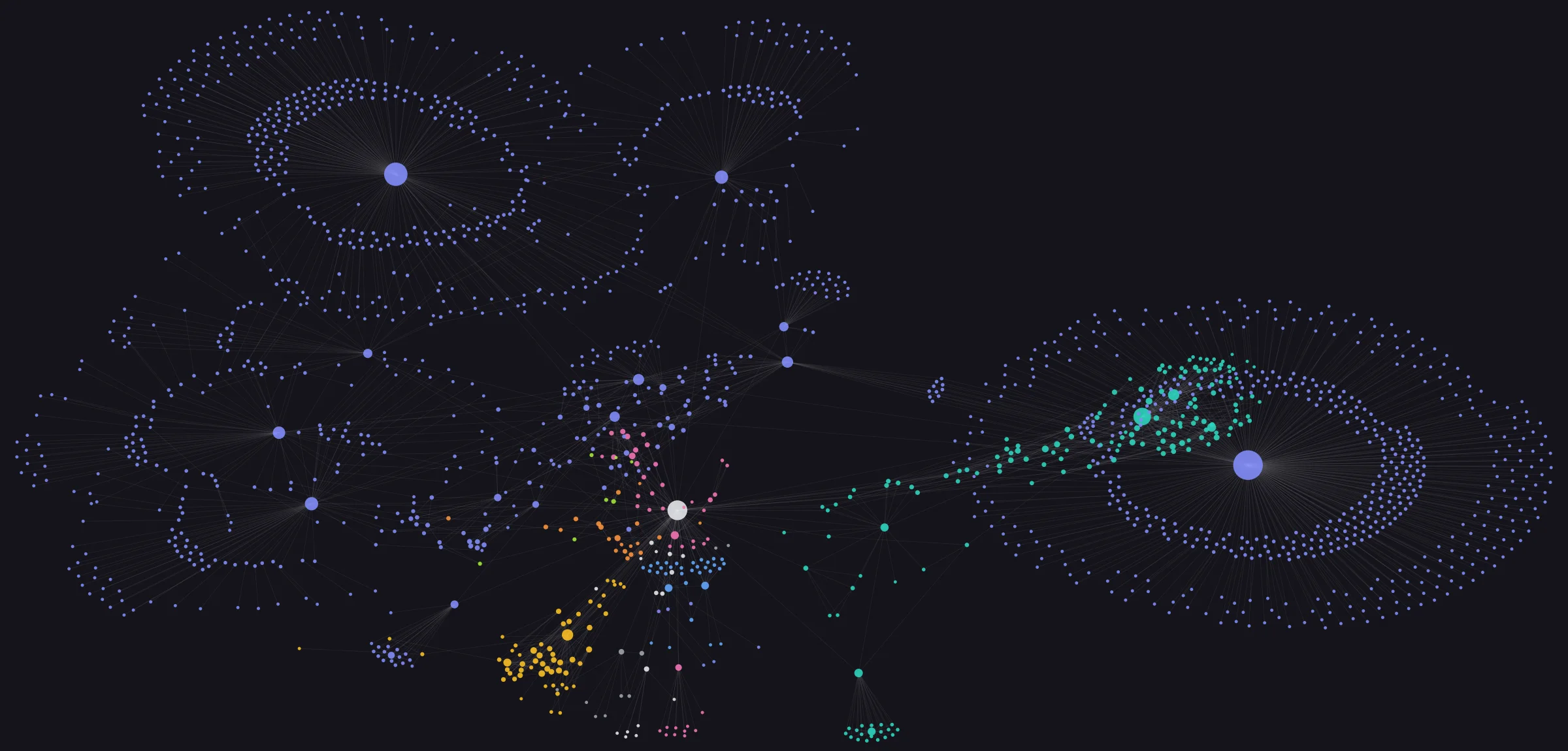
The base drawn from its own links. Each dot is a note and each line is a link between notes, coloured by product area (labels removed). 2,498 markdown notes, 2,540 internal links.
What the shape says. The big wheels are index pages fanning out to hundreds of feature notes. That is good for navigation, but notes average about two links and 685 (27%) have none, so the lateral links a PRD match depends on are still sparse.
What the notes are about
1,673 content notes by category (index, memory and session files excluded).
So what
About 83% of content notes describe features, mostly in one product area. That is the backbone, but the categories that feed a PRD match, use cases, demo scenarios and customer questions, are thin. My next seeding effort should go there, not into more feature pages.
How trustworthy is it today?
Share of the 1,673 content notes (format check across all 2,498).
Valid note format
2,477 of 2,498 notes carry the required frontmatter
Link at least one source
963 notes; the rest are gaps still to source
Have a citations section
740 notes
Approved
20 notes. 942 are drafts and about 670 carry no status yet
The honest reading: the format is enforced, sources are present on a majority of notes, and the promotion gate has barely been used. Most knowledge is still draft. That is the first thing I would fix, because an approved note is the only kind I want agents and the Q&A assistant to rely on. Only 2 notes are release-tagged today, which is why the release-to-visibility gap is still open.
Scale and activity
3,000+
files in one shared repository
6
domain PMs, each owning an area
23
pull requests closed (as of Nov 2026)
10
demo-ready AI agents built on the base
55/55
automated governance and routing checks (at last count)
Lines added in example weeks
GitHub Insights, code frequency. Examples, not the full series.
The base grew in large bursts while the structure and first areas were seeded, and it is still being changed in November. Lines added overstate real growth, since a folder rename counts as both added and deleted lines, so read this as evidence of ongoing work, not of value.
The audit
Reviewing my own build as an AI-native PM
A good build is not a proven product. I scored the base on six dimensions, on my own judgement, against what the benchmarks suggest good looks like. The pattern is typical: strong on structure and trust by design, thin on measurement and freshness.
Findability
Today 4 / 5 → target 5 / 5
Fixed taxonomy and an index in every folder make routing predictable. Missing: usage data to show where people still get lost.
Trust and traceability
Today 3 / 5 → target 5 / 5
The mechanism works, its coverage does not yet. In the Oct 2026 snapshot 58% of content notes link at least one source, 44% carry a citations section and only 20 notes are approved. Missing: automated checks that a citation really supports its claim.
Freshness
Today 2 / 5 → target 4 / 5
Diff-first refresh works on request. A scheduled refresh and visible review-by dates are designed but not live.
Coverage
Today 2 / 5 → target 4 / 5
About 83% of content notes describe features, mostly in one product area. Use cases (17), demo scenarios (4) and customer-question notes (53) are thin, and some areas are still scaffolds, so agents will sound confident where content is rich and be blind elsewhere.
Connectedness
Today 2 / 5 → target 4 / 5
Notes average about two links each and 27% have none. The structure is hub-and-spoke: great for navigation, weak on the lateral links (feature to use case to questionnaire answer) that make a PRD match possible.
Adoption and measurement
Today 1 / 5 → target 4 / 5
No usage telemetry, baselines or KPI view yet. This is the biggest gap between a good build and a proven product.
Loop closure with delivery
Today 2 / 5 → target 4 / 5
The PRD is already written against the base. Independent holdout scenarios and defect-to-spec traceability are not in place.
The improvement backlog
Ordered by impact on trust first, then on measurement. P0 items make the base provable; P1 hard-wires it into delivery; P2 widens adoption.
| Priority | Improvement | What it involves | Benchmark or evidence |
|---|---|---|---|
| P0 | KB health dashboard and a freshness SLA | Add a review-by date to the note schema; flag notes past their release cycle; publish weekly coverage, approval, open-gap and staleness numbers. A page from two releases ago looks as authoritative as one from yesterday. | Spotify manages Backstage to measured adoption and onboarding time; GitLab instruments handbook usage. |
| P0 | Golden-question eval set | Turn each team’s top 20 questions (already the acceptance tests in the PRD) into a nightly run: answered, abstained or wrong, plus a citation-support check. | Only 51.5% of sentences were fully supported by their citations in public generative search (Liu et al.). |
| P0 | Holdout acceptance scenarios | Generate end-to-end scenarios from use cases, demo scripts and customer questions; keep them outside the repo the agents build in. | Design principle: the builder should not grade its own work. DORA 2024 associated higher AI adoption with lower delivery stability (survey association, not causal). |
| P1 | Hard link between PRD, spec and knowledge | PRDs and the specs derived from them must cite note IDs, and the gate fails on uncited claims about existing behaviour. Expose the base through an MCP server and an agent briefing file so any agent can use governed knowledge. | MCP and AGENTS.md were placed under the Linux Foundation’s Agentic AI Foundation in Dec 2025. Source |
| P1 | Automated match report for every PRD draft | Check each requirement against technical knowledge and the market and customer evidence, and report fit, gaps, conflicts and feasibility before the PRD is reviewed. | Makes the core idea of the base, matching direction to what can be built, repeatable instead of PM-dependent. |
| P1 | Question log as a content backlog | Log every unanswered question as a gap and rank by frequency. This is the demand signal for what to write next, so coverage follows need. The self-service front door (see “The front door”) already turns unanswered questions into typed, routed tickets; the next step is to rank them and feed them back into the content plan. | Product-led logic: unmet demand beats a guessed content plan. |
| P1 | Scheduled, diff-first refresh from trackers and wiki | A routine queries what changed since each source’s last sync and raises a proposal for the owner. Never a silent write. | Already designed; closes the freshness gap. |
| P2 | Rendered read-only site | Give people who do not use git a searchable site with the same cited notes. | Spotify’s Backstage was adopted voluntarily because it was the easy path; GitLab’s handbook is a website, not a repo. |
| P2 | Defect-to-spec traceability | Have autonomous bug resolution record which spec or work package each defect traces to, and feed it back as a gap. | Closes the loop from outcome to intent. |
| P2 | Coverage fill and coverage labels | Fill platform areas first, and let answers state how well-covered their area is so confidence matches evidence. | Agents are confident where content is rich and blind where it is thin. |
P0
Improvement
KB health dashboard and a freshness SLA
What it involves
Add a review-by date to the note schema; flag notes past their release cycle; publish weekly coverage, approval, open-gap and staleness numbers. A page from two releases ago looks as authoritative as one from yesterday.
Benchmark or evidence
Spotify manages Backstage to measured adoption and onboarding time; GitLab instruments handbook usage.
P0
Improvement
Golden-question eval set
What it involves
Turn each team’s top 20 questions (already the acceptance tests in the PRD) into a nightly run: answered, abstained or wrong, plus a citation-support check.
Benchmark or evidence
Only 51.5% of sentences were fully supported by their citations in public generative search (Liu et al.).
P0
Improvement
Holdout acceptance scenarios
What it involves
Generate end-to-end scenarios from use cases, demo scripts and customer questions; keep them outside the repo the agents build in.
Benchmark or evidence
Design principle: the builder should not grade its own work. DORA 2024 associated higher AI adoption with lower delivery stability (survey association, not causal).
P1
Improvement
Hard link between PRD, spec and knowledge
What it involves
PRDs and the specs derived from them must cite note IDs, and the gate fails on uncited claims about existing behaviour. Expose the base through an MCP server and an agent briefing file so any agent can use governed knowledge.
Benchmark or evidence
MCP and AGENTS.md were placed under the Linux Foundation’s Agentic AI Foundation in Dec 2025. Source
P1
Improvement
Automated match report for every PRD draft
What it involves
Check each requirement against technical knowledge and the market and customer evidence, and report fit, gaps, conflicts and feasibility before the PRD is reviewed.
Benchmark or evidence
Makes the core idea of the base, matching direction to what can be built, repeatable instead of PM-dependent.
P1
Improvement
Question log as a content backlog
What it involves
Log every unanswered question as a gap and rank by frequency. This is the demand signal for what to write next, so coverage follows need. The self-service front door (see “The front door”) already turns unanswered questions into typed, routed tickets; the next step is to rank them and feed them back into the content plan.
Benchmark or evidence
Product-led logic: unmet demand beats a guessed content plan.
P1
Improvement
Scheduled, diff-first refresh from trackers and wiki
What it involves
A routine queries what changed since each source’s last sync and raises a proposal for the owner. Never a silent write.
Benchmark or evidence
Already designed; closes the freshness gap.
P2
Improvement
Rendered read-only site
What it involves
Give people who do not use git a searchable site with the same cited notes.
Benchmark or evidence
Spotify’s Backstage was adopted voluntarily because it was the easy path; GitLab’s handbook is a website, not a repo.
P2
Improvement
Defect-to-spec traceability
What it involves
Have autonomous bug resolution record which spec or work package each defect traces to, and feed it back as a gap.
Benchmark or evidence
Closes the loop from outcome to intent.
P2
Improvement
Coverage fill and coverage labels
What it involves
Fill platform areas first, and let answers state how well-covered their area is so confidence matches evidence.
Benchmark or evidence
Agents are confident where content is rich and blind where it is thin.
Measurement
How I would prove it works
My reported outcomes are self-reported, and I would rather say so than overstate them. Here is the measurement plan for making them rigorous: each metric anchored to a public benchmark where one exists, with a proposed target that is a hypothesis, to be replaced by a real baseline in the first release cycle.
| Metric | How to measure | Anchor | Proposed target |
|---|---|---|---|
| Time to a sourced answer | Timed sample of golden questions: self-serve vs ask a PM | ~19% of the workweek is spent searching for and gathering information (McKinsey Global Institute, 2012). Directional, dated. | Under 5 min for 80% of golden questions |
| PM deflection rate | Questions answered from the base ÷ questions logged | No clean public benchmark. Baseline first. | ≥ 50% within two release cycles |
| Citation coverage | CI check: notes with a source link or an explicit gap | Measured baseline, Oct 2026 snapshot: 58% of content notes link a source, 44% have a citations section | 100% for new notes, enforced; 90% for the back catalogue |
| Citation validity | Sampled check: does the source support the claim? | 51.5% full support in public engines (Liu et al.) | ≥ 90% |
| Freshness | Approved notes verified within the current release cycle | No public benchmark | ≥ 90% |
| Release-to-visibility lag | Days from release to the feature note being merged | The gap the base exists to close | ≤ 5 working days |
| New-hire ramp | Time to first independent customer conversation | Spotify (self-reported): −55% to 10th PR; ~60 → 20 days | Halve the baseline |
| Questionnaire reuse | Share of questions answered from approved notes | +10% RFP volume (Loopio), +43% proposals (Responsive) | ≥ 50% by the third questionnaire |
| Grounded-spec rate | Spec claims about current behaviour that cite a note | No public benchmark | ≥ 90%, as a gate |
Time to a sourced answer
How to measure
Timed sample of golden questions: self-serve vs ask a PM
Anchor
~19% of the workweek is spent searching for and gathering information (McKinsey Global Institute, 2012). Directional, dated.
Proposed target
Under 5 min for 80% of golden questions
PM deflection rate
How to measure
Questions answered from the base ÷ questions logged
Anchor
No clean public benchmark. Baseline first.
Proposed target
≥ 50% within two release cycles
Citation coverage
How to measure
CI check: notes with a source link or an explicit gap
Anchor
Measured baseline, Oct 2026 snapshot: 58% of content notes link a source, 44% have a citations section
Proposed target
100% for new notes, enforced; 90% for the back catalogue
Citation validity
How to measure
Sampled check: does the source support the claim?
Anchor
51.5% full support in public engines (Liu et al.)
Proposed target
≥ 90%
Freshness
How to measure
Approved notes verified within the current release cycle
Anchor
No public benchmark
Proposed target
≥ 90%
Release-to-visibility lag
How to measure
Days from release to the feature note being merged
Anchor
The gap the base exists to close
Proposed target
≤ 5 working days
New-hire ramp
How to measure
Time to first independent customer conversation
Anchor
Spotify (self-reported): −55% to 10th PR; ~60 → 20 days
Proposed target
Halve the baseline
Questionnaire reuse
How to measure
Share of questions answered from approved notes
Anchor
+10% RFP volume (Loopio), +43% proposals (Responsive)
Proposed target
≥ 50% by the third questionnaire
Grounded-spec rate
How to measure
Spec claims about current behaviour that cite a note
Anchor
No public benchmark
Proposed target
≥ 90%, as a gate
What it could be worth: an interactive model
Adjust the sliders to your own organisation. The assumptions behind the maths are stated under the result.
Hours returned to the org, per year
862
≈ 0.54 FTE · ≈ €64,620 of capacity
- PM time freed from repeat questions442 h
- Questionnaire effort avoided180 h
- Faster new-hire ramp-up240 h
Illustrative model, not a measured result. Assumes 46 working weeks, a 60% effort cut on a repeated questionnaire answer (mid-range of vendor-claimed savings, directional) and 50% lost output while a new hire ramps. Replace the sliders with your own numbers before quoting anything.
Lessons and playbook
Lessons, and how another PM team could start
01
Structure beats volume
02
Don’t blur distinct things
03
Fold, don’t fragment
04
Make gaps visible
05
Enforce in tooling
A six-step start
- List each team’s most common questions, including your most repeated questionnaire questions.
- Fix the taxonomy, note format and indexes before anyone writes.
- Name an owner per area and turn on required reviews.
- Seed one area, starting with feature documentation and customer questions.
- Add ingest, validate and diff-first refresh, then schedule the refresh.
- Open a read-only, cite-or-abstain Q&A assistant and test it against your question list.
Product knowledge is a product in its own right, with users, owners and a release cadence. Build it that way, and the organisation stops asking “who knows about this?” and starts asking “what does the knowledge base say, and where did it get that?”
Plain-language glossary
| Term | Meaning here |
|---|---|
| PRD | Product requirements document: what to build and why. |
| RFP / RFQ | A customer’s formal request for proposal or quotation, usually with a long questionnaire. |
| Cite or abstain | Every answer points to a source, or says plainly that it does not know. |
| RAG | Retrieval-augmented generation: an AI looks up documents first, then writes its answer from them. |
| Git, pull request | Version control that records every change; a pull request is a proposed change that others review before it is merged. |
| CODEOWNERS, CI | A file naming who must approve changes to each path; CI is an automatic check that runs on every proposed change. |
| Frontmatter, OKF | Structured fields at the top of a markdown note; the Open Knowledge Format is the open note shape this base builds on. |
| Vault | The local folder of notes a PM works in (here, an Obsidian vault that is a git clone). |
| Holdout scenarios | Acceptance tests kept where the builder cannot see them, so it cannot tune its work to pass. |
| MCP, AGENTS.md | Open standards for letting AI agents reach tools and data, and for briefing them on a project. |
| WSJF, P85 | A prioritisation method (weighted shortest job first); P85 means the date 85% of past jobs finished by. |
PRD
Meaning here
Product requirements document: what to build and why.
RFP / RFQ
Meaning here
A customer’s formal request for proposal or quotation, usually with a long questionnaire.
Cite or abstain
Meaning here
Every answer points to a source, or says plainly that it does not know.
RAG
Meaning here
Retrieval-augmented generation: an AI looks up documents first, then writes its answer from them.
Git, pull request
Meaning here
Version control that records every change; a pull request is a proposed change that others review before it is merged.
CODEOWNERS, CI
Meaning here
A file naming who must approve changes to each path; CI is an automatic check that runs on every proposed change.
Frontmatter, OKF
Meaning here
Structured fields at the top of a markdown note; the Open Knowledge Format is the open note shape this base builds on.
Vault
Meaning here
The local folder of notes a PM works in (here, an Obsidian vault that is a git clone).
Holdout scenarios
Meaning here
Acceptance tests kept where the builder cannot see them, so it cannot tune its work to pass.
MCP, AGENTS.md
Meaning here
Open standards for letting AI agents reach tools and data, and for briefing them on a project.
WSJF, P85
Meaning here
A prioritisation method (weighted shortest job first); P85 means the date 85% of past jobs finished by.
Sources
- Dan Shapiro, The Five Levels: from Spicy Autocomplete to the Software Factory (Jan 2026)
- Spotify, how we measure Backstage success
- Backstage docs, adopting Backstage
- The New Stack, Spotify’s voluntary platform adoption
- GitLab Handbook, about
- Mintlify, how Stripe creates its documentation
- Loopio, 2021 RFP Response Trends Report
- Responsive, RFP automation stats
- Liu, Zhang, Liang, Evaluating Verifiability in Generative Search Engines (2023)
- Wallat et al., Correctness is not Faithfulness in RAG Attributions (2024)
- McKinsey Global Institute, The social economy (2012)
- Google Cloud, Announcing the 2024 DORA report
- Linux Foundation, formation of the Agentic AI Foundation (Dec 2025)
- Spotify Engineering, how Backstage made developers more effective (2021)
Industry adoption figures are directional and come from different populations and definitions. Internal descriptions are based on company documentation as of October 2026. The scorecard, targets and the interactive model are my own judgement and illustration, not measured results.